ChipApex | Global Electronic Components Supplier

SEARCH
Search Product
Search Post
— IC芯片 | 连接器 | 传感器 | 被动器件 —
Search productSearch post
— IC芯片 | 连接器 | 传感器 | 被动器件 —
Consult the customer manager about the wholesale price.
consultation hotline:86-132-6715-2157
email:[email protected]
Contact the product manager for consultation. One-stop consultation is available.
Do you want a lower wholesale price? Please send us your inquiry and we will reply immediately.
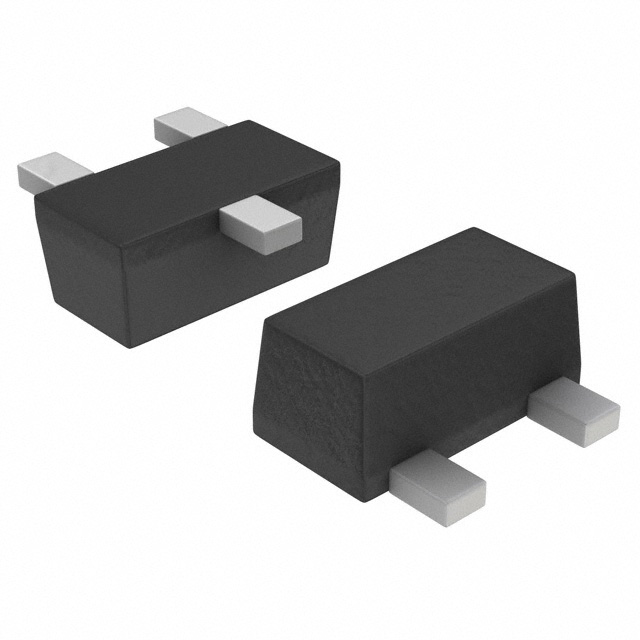
The DTC143ZEBTL is a single NPN digital transistor manufactured by ROHM Semiconductor, housed in an SOT-416 (EMT3) surface-mount package. It integrates bias resistors with typical values of R1 = 4.7 kΩ and R2 = 47 kΩ, yielding a ratio of 10. Key electrical parameters include a collector-emitter breakdown voltage (VCEO) of 50 V, a continuous collector current (IC) of 100 mA, and a power dissipation (PD) of 150 mW. The device features a minimum DC current gain (hFE) of 80 at IC = 10 mA and VCE = 5 V, with a transition frequency (fT) of 250 MHz. Operating temperatures range from -55°C to +150°C.
Verify the specific suffix 'BTL' against the manufacturer's official datasheet to confirm tape-and-reel packaging specifications and quantity per reel. Ensure the ordering part number matches the exact RoHS compliance status and lead time requirements defined in the latest production documentation. Cross-reference distributor listings with the official ROHM database to avoid counterfeit components.
Select this component when a single NPN digital transistor with a 10:1 resistor ratio is required. Compare the 150 mW power dissipation limit against thermal constraints in the target application. Verify that the 50 V collector-emitter voltage rating exceeds the maximum operating voltage. Consider the SOT-416 footprint compatibility during PCB layout design.
This part belongs to the ROHM DTC143 series of pre-biased NPN transistors. It shares the same internal circuit topology and electrical characteristics as the DTC143ZE and DTC143ZETL variants, differing primarily in packaging format or reel configuration. The series is designed for standard commercial applications rather than automotive-grade environments.
Direct substitutes within the same family include DTC143ZE and DTC143ZETL, which share identical electrical specifications. Verify pinout compatibility and physical dimensions before substitution. Alternative manufacturers may offer functionally equivalent parts, but parameter tolerances and thermal performance should be validated against the original datasheet.
 DTC143ZEBTL

The activity of extra discounts on wholesale prices is in full swing…
Please fill in your contact information and we will send you the latest wholesale price list.