ChipApex | Global Electronic Components Supplier
SEARCH
Search Product
Search Post
— IC芯片 | 连接器 | 传感器 | 被动器件 —
Search productSearch post
— IC芯片 | 连接器 | 传感器 | 被动器件 —
Consult the customer manager about the wholesale price.
consultation hotline:86-132-6715-2157
email:[email protected]
Contact the product manager for consultation. One-stop consultation is available.
Do you want a lower wholesale price? Please send us your inquiry and we will reply immediately.
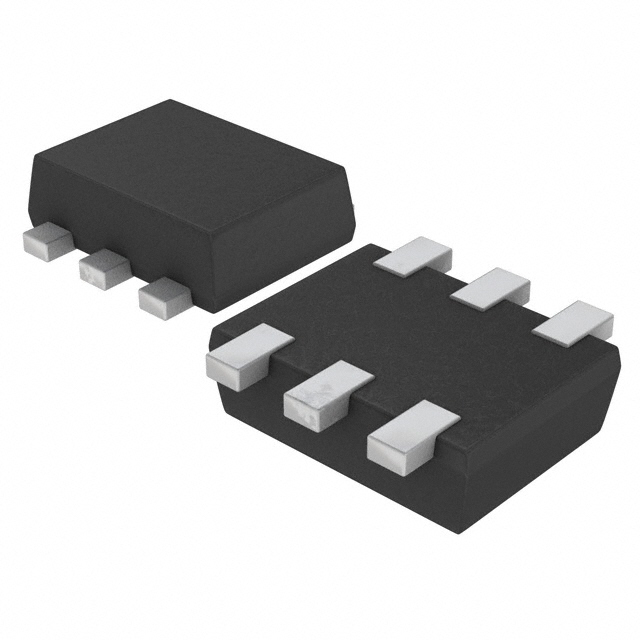
The EMT1T2R is a dual PNP bipolar junction transistor (BJT) manufactured by ROHM Semiconductor. It integrates two independent 2SA1037AK chips within a compact SC-107C (SOT-563) surface-mount package. The device supports a collector-emitter voltage of -50V and a continuous collector current of -150mA per element. Key electrical characteristics include a minimum DC current gain (hFE) of 120, a maximum operating temperature of 150°C, and a power dissipation rating of 150mW. The component is lead-free, RoHS compliant, and designed for general-purpose small-signal amplification.
Verify the specific ordering suffix to confirm the tape-and-reel packaging configuration. Ensure the procurement documentation explicitly states compliance with RoHS directives and confirms the absence of lead. Cross-reference the manufacturer part number against official ROHM databases to validate authenticity before integration into production schedules.
Select this component when space-constrained designs require two matched PNP transistors with high isolation. The SC-107C package offers a footprint smaller than individual discrete equivalents. Verify that the required collector current does not exceed 150mA and that the circuit operates within the specified 150°C thermal limit.
This part belongs to the EMT1 series of general-purpose dual transistors from ROHM. It serves as a surface-mount replacement for through-hole discrete components, facilitating automated assembly processes. The series is engineered to provide consistent performance in compact consumer electronics and industrial control applications requiring reliable signal amplification.
The datasheet identifies the 2SA1037AK as the equivalent single-part reference. Designers replacing discrete units should verify pinout compatibility and ensure the new design accommodates the integrated dual-element configuration.
It contains two independent PNP transistor chips based on the 2SA1037AK specification within a single six-terminal package.
No, the product documentation explicitly states that this component is not recommended for use in automotive equipment.
The maximum operating temperature is 150°C.
 EMT1T2R
The activity of extra discounts on wholesale prices is in full swing…
Please fill in your contact information and we will send you the latest wholesale price list.