 ChipApex | Global Electronic Components Supplier
SEARCH
Search Product
Search Post
— IC芯片 | 连接器 | 传感器 | 被动器件 —
Search productSearch post
— IC芯片 | 连接器 | 传感器 | 被动器件 —
Consult the customer manager about the wholesale price.
consultation hotline:86-132-6715-2157
email:[email protected]
Contact the product manager for consultation. One-stop consultation is available.
Do you want a lower wholesale price? Please send us your inquiry and we will reply immediately.
The GBJ3506ULV_T0_00601 is a single-phase bridge rectifier manufactured by Panjit International Inc. It features an ultra-low forward voltage design utilizing oxide planar chip junction technology with PI protection layers. The device is housed in the GBJ-2-4 through-hole package, providing a continuous forward current rating of 35 A and a maximum repetitive peak reverse voltage of 600 V. Key electrical specifications include a maximum non-repetitive peak forward surge current of 720 A at 8.3 ms single half-sine-wave, a typical forward voltage drop of 1.0 V at rated current, and a maximum reverse leakage current of 5 uA at 600 V. The component operates within a junction temperature range of -55°C to +150°C.
Verify the specific ordering suffix against official Panjit documentation to confirm exact packaging configuration and compliance status. Ensure that the procurement channel provides valid traceability data matching the manufacturer's part identification. Cross-reference the datasheet revision date to guarantee alignment with current manufacturing specifications before finalizing orders.
Select this component when low conduction losses are critical in high-current designs. The 35 A rating supports substantial load requirements while the 600 V blocking capability accommodates standard mains voltages. Verify thermal management strategies align with the 150°C maximum junction temperature limit under expected operating conditions.
This model belongs to Panjit's GBJ series of glass passivated bridge rectifiers. The ULV designation indicates an optimized variant focused on reducing forward voltage drop compared to standard counterparts. It shares the mechanical footprint of the GBJ-2-4 package family, facilitating compatibility with existing board layouts designed for similar current ratings.
Direct substitutes include other 35 A, 600 V bridge rectifiers in the GBJ-2-4 package such as the GBJ3506 or GBJ3506H from Panjit. Verify forward voltage and thermal resistance parameters match application requirements when considering alternatives from different manufacturers.
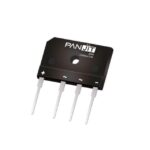 GBJ3506ULV_T0_00601
The activity of extra discounts on wholesale prices is in full swing…
Please fill in your contact information and we will send you the latest wholesale price list.





