ChipApex | Global Electronic Components Supplier

SEARCH
Search Product
Search Post
— IC芯片 | 连接器 | 传感器 | 被动器件 —
Search productSearch post
— IC芯片 | 连接器 | 传感器 | 被动器件 —
Consult the customer manager about the wholesale price.
consultation hotline:86-132-6715-2157
email:[email protected]
Contact the product manager for consultation. One-stop consultation is available.
Do you want a lower wholesale price? Please send us your inquiry and we will reply immediately.
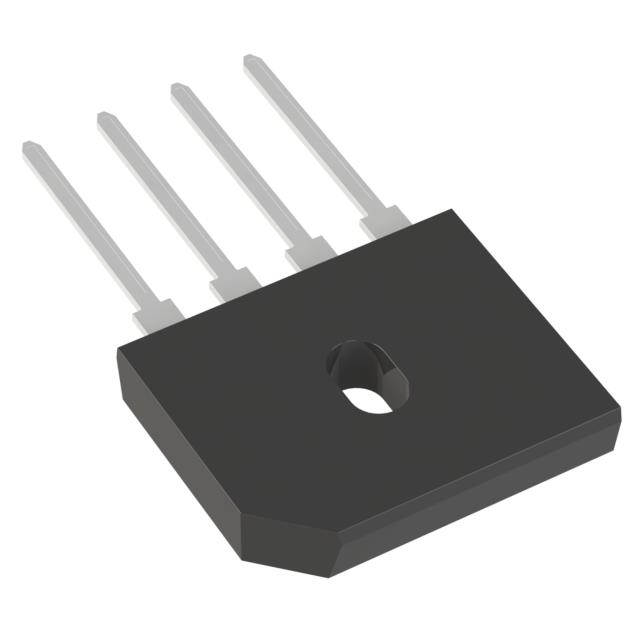
The GBU25KH is a single-phase standard recovery bridge rectifier manufactured by Diodes Incorporated. It features glass passivated die construction and is rated for a peak repetitive reverse voltage of 800V. The device supports an average forward rectified current of 25A with a heatsink, or 3.6A without one. It withstands a non-repetitive peak forward surge current of 350A. The maximum forward voltage is 1.05V at 12.5A, with a typical reverse leakage current of 10µA. Operating temperature ranges from -55°C to +175°C. It utilizes a GBU through-hole package.
Verify the specific ordering suffix against manufacturer documentation to confirm packaging details. Confirm compliance requirements such as RoHS and halogen-free status prior to procurement. Ensure the supplier provides valid traceability documents. Check for automotive qualification if AEC-Q standards are required for the target application environment.
Select this component when an 800V reverse voltage rating is necessary for the circuit design. Ensure the thermal management strategy accommodates the 25A continuous current requirement with an appropriate heatsink. Verify that the PCB layout supports the GBU package dimensions and mounting torque specifications for secure mechanical attachment.
This component belongs to the GBU series of bridge rectifiers from Diodes Incorporated. The series offers various voltage ratings and current capacities within the same physical footprint. The GBU25KH specifically targets applications requiring high voltage isolation combined with significant current handling capabilities in a compact through-hole form factor.
Direct replacements must match the 800V PRV, 25A IF(AV), and GBU package outline. Verify forward voltage drop and thermal resistance characteristics to ensure equivalent performance. Consult manufacturer cross-reference lists for confirmed compatible part numbers before implementation.
The maximum operating junction temperature range extends up to +175°C.
Polarity markings are molded directly onto the body of the component.
The typical thermal resistance (RθJC) is 1.7°C/W.
 GBU25KH

The activity of extra discounts on wholesale prices is in full swing…
Please fill in your contact information and we will send you the latest wholesale price list.