 ChipApex | Global Electronic Components Supplier

SEARCH
Search Product
Search Post
— IC芯片 | 连接器 | 传感器 | 被动器件 —
Search productSearch post
— IC芯片 | 连接器 | 传感器 | 被动器件 —
Consult the customer manager about the wholesale price.
consultation hotline:86-132-6715-2157
email:[email protected]
Contact the product manager for consultation. One-stop consultation is available.
Do you want a lower wholesale price? Please send us your inquiry and we will reply immediately.
The MDD GBU406 is a single-phase glass passivated bridge rectifier designed for through-hole mounting. It features a molded plastic body with a maximum average forward rectified current of 4.0 A and a repetitive peak reverse voltage of 600 V. The device supports a peak forward surge current of 150 A under JEDEC testing conditions. Electrical characteristics include a maximum forward voltage of 1.1 V at 2.0 A DC and a reverse leakage current of 10 µA at 25°C. Operating junction temperatures range from -55°C to +150°C, with a thermal resistance of 2.2 °C/W.
Verify the original manufacturer designation as MDD against the specific part code GBU0406000L460 found in the provided specification sheet. Confirm that the component matches the GBU series physical dimensions and terminal configuration required for your assembly. Ensure compliance with RoHS standards if applicable to your manufacturing process.
Select this component when a 4 A current rating and 600 V blocking voltage are required for through-hole PCB mounting. Consider the 150 A surge capability for inrush protection needs. Verify that the operating temperature range of -55°C to +150°C aligns with your environmental specifications.
This component belongs to the GBU series of single-phase bridge rectifiers manufactured by MDD. The series includes variants with different voltage ratings while maintaining the same 4 A current capacity and GBU package form factor. It is designed as a general-purpose replacement for standard bridge rectifier applications.
Cross-reference part numbers such as GBU406 from other manufacturers like Comchip or LGE may be compatible if electrical parameters match exactly. Verify pinout orientation and physical dimensions before substitution.
The peak forward surge current (IFSM) is rated at 150 A for an 8.3 ms single half sine-wave superimposed on rated load, tested per JEDEC method.
The maximum forward voltage (VF) is 1.1 V measured at 2.0 A DC.
Yes, the operating junction temperature range extends up to +150°C, and it undergoes rigorous reliability testing including high-temperature storage life tests.
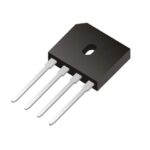 GBU406

The activity of extra discounts on wholesale prices is in full swing…
Please fill in your contact information and we will send you the latest wholesale price list.





