ChipApex | Global Electronic Components Supplier

SEARCH
Search Product
Search Post
— IC芯片 | 连接器 | 传感器 | 被动器件 —
Search productSearch post
— IC芯片 | 连接器 | 传感器 | 被动器件 —
Consult the customer manager about the wholesale price.
consultation hotline:86-132-6715-2157
email:[email protected]
Contact the product manager for consultation. One-stop consultation is available.
Do you want a lower wholesale price? Please send us your inquiry and we will reply immediately.
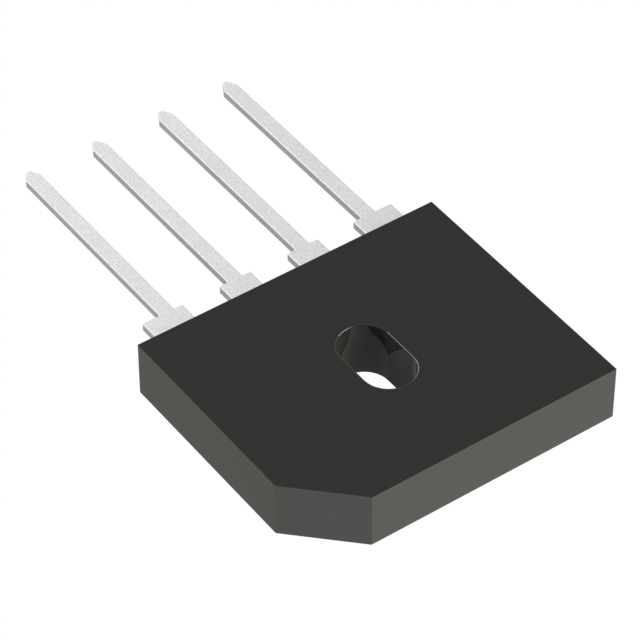
The GBU6K-T is a single-phase bridge rectifier manufactured by Diotec Semiconductor, designed for general-purpose power supply applications. It features a peak repetitive reverse voltage of 1000 V and an average forward rectified current of 6 A. The device utilizes glass passivated chip junctions to ensure high reliability and long-term stability under demanding conditions. It is housed in the GBU-4 through-hole package, which provides robust mechanical strength and efficient heat dissipation capabilities. The component supports a maximum surge current of 200 A and operates within a junction temperature range of -55°C to +175°C.
Verify the specific suffix 'T' indicates tape and reel packaging when sourcing. Confirm the manufacturer part number matches Diotec Semiconductor's official documentation. Ensure the order quantity aligns with standard reel sizes if automated placement is required. Cross-reference the datasheet for exact thermal resistance values relevant to your PCB layout.
Select this component when a 6 A current rating and 1000 V reverse voltage are required in a through-hole configuration. Compare thermal performance against surface-mount alternatives if space constraints exist. Verify that the operating environment temperature does not exceed the specified junction limits without adequate heatsinking. Check compatibility with existing PCB footprints for the GBU-4 package.
The GBU series represents Diotec Semiconductor's line of high-current bridge rectifiers. The GBU6K-T belongs to the 6 A category within this family, offering a balance between current handling capacity and physical size. This series is widely used in consumer electronics and industrial equipment where reliable AC-to-DC conversion is essential.
Direct substitutes include other 6 A, 1000 V bridge rectifiers in the GBU-4 package from manufacturers such as Littelfuse or Vishay. Ensure equivalent forward voltage drop and reverse leakage characteristics. Verify pinout compatibility and mechanical dimensions before substitution.
 GBU6K-T

The activity of extra discounts on wholesale prices is in full swing…
Please fill in your contact information and we will send you the latest wholesale price list.