 ChipApex | Global Electronic Components Supplier

SEARCH
Search Product
Search Post
— IC芯片 | 连接器 | 传感器 | 被动器件 —
Search productSearch post
— IC芯片 | 连接器 | 传感器 | 被动器件 —
Consult the customer manager about the wholesale price.
consultation hotline:86-132-6715-2157
email:[email protected]
Contact the product manager for consultation. One-stop consultation is available.
Do you want a lower wholesale price? Please send us your inquiry and we will reply immediately.
The GSIB2580-E3/45 is a single-phase single in-line bridge rectifier from Vishay General Semiconductor, utilizing the GSIB-5S package. It features a maximum repetitive peak reverse voltage (VRRM) of 800 V and a maximum average forward rectified output current (IF(AV)) of 25 A at a case temperature of 98 °C. The device supports a peak forward surge current (IFSM) of 350 A with a maximum instantaneous forward voltage drop of 1.0 V at 12.5 A. Electrical characteristics include a maximum DC reverse current of 10 μA at 25 °C and 350 μA at 125 °C. The operating junction and storage temperature range extends from -55 to +150 °C.
Verify component authenticity by cross-referencing the part number GSIB2580-E3/45 with official Vishay documentation. Confirm that the E3 suffix indicates RoHS compliance and commercial grade material categorization. Ensure the /45 delivery mode matches specific logistical requirements. Validate technical specifications against the latest datasheet revision 09-Jul-2020 before integration into designs.
Select this component when an 800 V reverse voltage rating is required alongside a 25 A continuous current capacity. The GSIB-5S package offers a thin profile suitable for space-constrained layouts. Consider the thermal resistance values for heatsink design, noting the difference between PCB mounting and aluminum plate heatsink scenarios. Ensure the application operates within the specified -55 to +150 °C temperature range.
This part belongs to the GSIB25xx series of single-phase single in-line bridge rectifiers, which includes variants with different voltage ratings such as GSIB2520, GSIB2540, and GSIB2560. All members share the same GSIB-5S case style and similar electrical structures, differing primarily in their maximum repetitive peak reverse voltage capabilities ranging from 200 V to 800 V.
Direct substitutes within the same family include GSIB2520, GSIB2540, and GSIB2560, provided the circuit voltage does not exceed their respective lower ratings. Verify pinout compatibility and thermal performance characteristics when swapping between these variants to ensure system integrity.
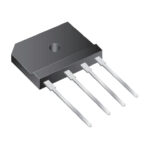 GSIB2580-E3/45

The activity of extra discounts on wholesale prices is in full swing…
Please fill in your contact information and we will send you the latest wholesale price list.





