 ChipApex | Global Electronic Components Supplier
SEARCH
Search Product
Search Post
— IC芯片 | 连接器 | 传感器 | 被动器件 —
Search productSearch post
— IC芯片 | 连接器 | 传感器 | 被动器件 —
Consult the customer manager about the wholesale price.
consultation hotline:86-132-6715-2157
email:[email protected]
Contact the product manager for consultation. One-stop consultation is available.
Do you want a lower wholesale price? Please send us your inquiry and we will reply immediately.
The HFDA801H-VYT is a fully digital Class-D audio amplifier from STMicroelectronics, housed in a 64-LQFP-EP (10x10 mm) package. It features an integrated 24-bit 120 dB DAC and supports I²S/TDM digital inputs up to 16 channels. The device operates on a wide supply voltage range of 4.5 V to 25 V, with a minimum of 5 V during turn-on transitions. It utilizes a 2 MHz PWM switching frequency to minimize external LC filter size. Key electrical specifications include typical output powers of 4 x 30 W at 4 Ω/14.4 V (10% THD), 4 x 25 W at 4 Ω/14.4 V (1% THD), and 4 x 80 W at 4 Ω/25 V (10% THD). It offers extremely low noise (13 µV A-weighted) and very low THD (0.02% at 1 W/1 kHz).
Verify the specific suffix 'H' against official ST documentation, as the provided datasheet references the 'A' variant. Confirm availability through authorized distributors. Ensure ESD handling protocols are followed due to the sensitivity of the CMOS components. Check for RoHS compliance status if required by your manufacturing standards.
Select this component for designs requiring high integration and advanced diagnostics in automotive environments. The 2 MHz switching frequency reduces passive component costs. Consider the LQFP64 package constraints for thermal management. Ensure the host system supports I²S or TDM interfaces for digital control.
This part belongs to the HFDA series of digital Class-D amplifiers designed for automotive use. It is AEC-Q100 qualified, ensuring reliability under automotive conditions. The series emphasizes high-fidelity audio performance combined with robust system protection features.
The HFDA801A is the primary documented equivalent in the provided datasheet. Verify pinout and software compatibility before substitution. Other HFDA variants may differ in channel count or power output.
The absolute maximum rating for transient supply voltage is 40 V for a duration of 100 ms.
The LC filter is included in the feedback loop, making the amplifier insensitive to filter non-linearity and optimizing THD across various load conditions.
Yes, channels can be paralleled to drive lower impedance loads, such as 1 Ω, with one channel acting as Master and the other as Slave.
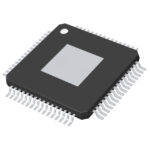 HFDA801H-VYT
The activity of extra discounts on wholesale prices is in full swing…
Please fill in your contact information and we will send you the latest wholesale price list.





