 ChipApex | Global Electronic Components Supplier
SEARCH
Search Product
Search Post
— IC芯片 | 连接器 | 传感器 | 被动器件 —
Search productSearch post
— IC芯片 | 连接器 | 传感器 | 被动器件 —
Consult the customer manager about the wholesale price.
consultation hotline:86-132-6715-2157
email:[email protected]
Contact the product manager for consultation. One-stop consultation is available.
Do you want a lower wholesale price? Please send us your inquiry and we will reply immediately.
The HMC734LP5 is a GaAs InGaP HBT MMIC Voltage Controlled Oscillator (VCO) from Analog Devices Inc. It operates in the 8.6 GHz to 10.2 GHz frequency range and integrates a divide-by-4 prescaler, providing a secondary output at Fo/4 (2.15–2.55 GHz). The device features a typical phase noise of -100 dBc/Hz at 100 kHz offset and delivers +17 dBm power output. It requires no external resonators or matching components. Key electrical parameters include a tuning voltage range of 1 VDC to 13 VDC, a supply voltage of 4.75 V to 5.25 V, and a current consumption of 240 mA. The component is housed in a QFN-32 package measuring 5.1 mm x 5.1 mm x 1 mm.
Verify the specific suffix (e.g., LP5 vs. LP5E) against the manufacturer's datasheet to confirm lead-free status and RoHS compliance details. Ensure the ordering part number matches the exact frequency range and package variant required for the design. Confirm availability through authorized distributors as supply status may vary. Cross-reference the ECAD model with PCB footprint requirements prior to procurement.
Select this component for applications requiring high-frequency synthesis with integrated division capabilities. The monolithic design simplifies layout by removing external passive components. Consider the 240 mA current draw and thermal management within the QFN-32 package. Verify that the 1 VDC to 13 VDC tuning voltage range aligns with the system's control interface. Evaluate the -100 dBc/Hz phase noise performance against system sensitivity requirements.
The HMC734LP5 belongs to the Hittite Microwave (now Analog Devices) HMC73x series of MMIC VCOs. These devices utilize GaAs InGaP HBT technology to provide robust performance in microwave frequencies. The series is characterized by its integration of active and passive elements on a single die, offering compact solutions for RF front-end designs. This specific model focuses on the 8.6–10.2 GHz band with built-in frequency division.
Public confirmed substitute part numbers are not available in the provided documentation. Consult Analog Devices technical support for direct replacements or cross-references.
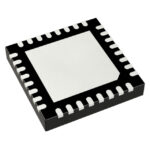 HMC734LP5
The activity of extra discounts on wholesale prices is in full swing…
Please fill in your contact information and we will send you the latest wholesale price list.





