 ChipApex | Global Electronic Components Supplier
SEARCH
Search Product
Search Post
— IC芯片 | 连接器 | 传感器 | 被动器件 —
Search productSearch post
— IC芯片 | 连接器 | 传感器 | 被动器件 —
Consult the customer manager about the wholesale price.
consultation hotline:86-132-6715-2157
email:[email protected]
Contact the product manager for consultation. One-stop consultation is available.
Do you want a lower wholesale price? Please send us your inquiry and we will reply immediately.
The HSG1002VE-TL-E is a SiGe HBT high-frequency low-noise amplifier manufactured by Renesas Electronics Corporation. It is designed for applications requiring signal amplification in the microwave frequency range. The device features a compact surface-mount package suitable for automated assembly. Key electrical characteristics include a specified noise figure and gain performance optimized for receiver front-end stages. The component operates within standard industrial temperature ranges and supports reliable integration into RF systems.
Verify the specific tape-and-reel quantity and moisture sensitivity level (MSL) classification prior to ordering, as these parameters are critical for surface-mount assembly processes. Confirm that the RoHS compliance status matches current environmental regulations for your target market. Ensure storage conditions adhere to the recommended humidity and temperature limits to prevent package degradation before soldering.
Select this component when a low noise figure and high gain are required for frequencies above 1 GHz. Compare the S-parameter data against system requirements for input and output return loss. Consider the thermal dissipation capabilities of the small outline package relative to the surrounding PCB copper area. Evaluate the trade-off between noise performance and power consumption for battery-operated devices.
This part belongs to the HSG100 series of high-frequency amplifiers from Renesas. It shares architectural similarities with the HSG1001 and HSG1003 models but offers distinct pinout and performance specifications tailored for specific frequency bands. The 'TL-E' suffix typically indicates the tape-and-reel packaging format with lead-free finish, distinguishing it from sample or bulk variants.
Direct replacements may include the HSG1001VD or HSG1003VE if pin compatibility and frequency coverage align with the design. Verify that substitute components meet the same noise figure and gain flatness requirements. Check for any differences in thermal resistance or package dimensions that might affect the existing PCB layout.
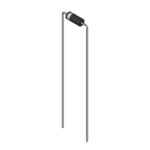 HSG1002VE-TL-E
The activity of extra discounts on wholesale prices is in full swing…
Please fill in your contact information and we will send you the latest wholesale price list.






