 ChipApex | Global Electronic Components Supplier

SEARCH
Search Product
Search Post
— IC芯片 | 连接器 | 传感器 | 被动器件 —
Search productSearch post
— IC芯片 | 连接器 | 传感器 | 被动器件 —
Consult the customer manager about the wholesale price.
consultation hotline:86-132-6715-2157
email:[email protected]
Contact the product manager for consultation. One-stop consultation is available.
Do you want a lower wholesale price? Please send us your inquiry and we will reply immediately.
The KBP005M-E4/51 is a glass passivated single-phase bridge rectifier manufactured by Vishay General Semiconductor. It features an average forward output rectified current of 1.5 A and a maximum repetitive peak reverse voltage of 50 V. The device supports a peak forward surge current of 60 A and operates within a junction temperature range of -55 °C to +150 °C. Electrical characteristics include a maximum instantaneous forward voltage drop of 1.0 V at 1.0 A and a maximum DC reverse current of 5.0 µA at rated blocking voltage. The component utilizes the KBPM case style with silver-plated leads.
Verify the specific ordering suffix, as /51 indicates delivery in anti-static PVC trays containing 600 units. Confirm RoHS compliance status against Directive 2011/65/EU requirements. Ensure the supplier provides valid documentation matching Document Number 88531. Validate that the received components match the KBPM case style and polarity markings before integration into production lines.
Select this component when a 50 V peak reverse voltage rating is required for low-voltage AC-to-DC conversion. The 1.5 A average current rating suits general-purpose applications where space is limited due to the compact KBPM through-hole package. Consider the thermal resistance values if operating near the upper ambient temperature limits or under continuous heavy loads.
This part belongs to the KBP005M thru KBP10M series, which shares identical mechanical dimensions and electrical ratings except for the voltage specifications. The E4 suffix denotes consumer grade components compliant with RoHS directives. The /51 packaging code specifically designates bulk tray distribution rather than tube packaging used in other variants like /45.
Direct replacements must maintain the 50 V VRRM rating and 1.5 A IF(AV) current capacity within the KBPM footprint. Verify that alternative manufacturers offer equivalent thermal resistance and forward voltage characteristics to ensure circuit performance remains unchanged during substitution.
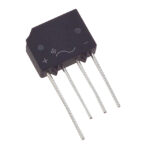 KBP005M-E4/51

The activity of extra discounts on wholesale prices is in full swing…
Please fill in your contact information and we will send you the latest wholesale price list.





