 ChipApex | Global Electronic Components Supplier

SEARCH
Search Product
Search Post
— IC芯片 | 连接器 | 传感器 | 被动器件 —
Search productSearch post
— IC芯片 | 连接器 | 传感器 | 被动器件 —
Consult the customer manager about the wholesale price.
consultation hotline:86-132-6715-2157
email:[email protected]
Contact the product manager for consultation. One-stop consultation is available.
Do you want a lower wholesale price? Please send us your inquiry and we will reply immediately.
The KBP04M/1 is a glass-passivated single-phase bridge rectifier manufactured by Vishay General Semiconductor - Diodes Division. It features a maximum average forward rectified current of 1.5 A and a maximum repetitive peak reverse voltage of 400 V. The device utilizes a KBP surface-mount case style, designed for printed circuit board applications. Key electrical characteristics include a maximum non-repetitive peak forward surge current of 50 A and a maximum DC forward voltage of 1 V. The component operates within a junction temperature range up to 150 °C and complies with RoHS 2002/95/EC standards.
Verify the specific suffix designation when ordering, as variations may exist in packaging or compliance documentation. Confirm that the procurement source references the official Vishay datasheet for the KBP series to ensure authenticity. Check for updated environmental compliance statements if required for specific regional regulations. Ensure the supplier provides traceability documentation consistent with Vishay manufacturing standards.
Select this component for designs requiring a 1.5 A rectification capacity with a 400 V reverse voltage rating. The KBP package is appropriate for surface-mount technology implementations where space constraints exist. Evaluate thermal management requirements based on the 150 °C maximum junction temperature limit. Consider the 50 A surge current rating for inrush protection scenarios in AC input stages.
This part belongs to the Vishay KBP series of glass-passivated single-phase bridge rectifiers. The series offers various voltage ratings while maintaining a consistent 1.5 A current capacity and standardized KBP footprint. These components are engineered for reliability in general-purpose rectification tasks across consumer and industrial electronics sectors.
Compatible replacements must match the 1.5 A current rating, 400 V reverse voltage, and KBP surface-mount package dimensions. Verify that alternative bridge rectifiers offer equivalent surge current capabilities and thermal performance characteristics.
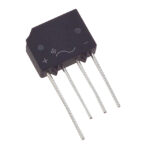 KBP04M/1

The activity of extra discounts on wholesale prices is in full swing…
Please fill in your contact information and we will send you the latest wholesale price list.





