ChipApex | Global Electronic Components Supplier

SEARCH
Search Product
Search Post
— IC芯片 | 连接器 | 传感器 | 被动器件 —
Search productSearch post
— IC芯片 | 连接器 | 传感器 | 被动器件 —
Consult the customer manager about the wholesale price.
consultation hotline:86-132-6715-2157
email:[email protected]
Contact the product manager for consultation. One-stop consultation is available.
Do you want a lower wholesale price? Please send us your inquiry and we will reply immediately.
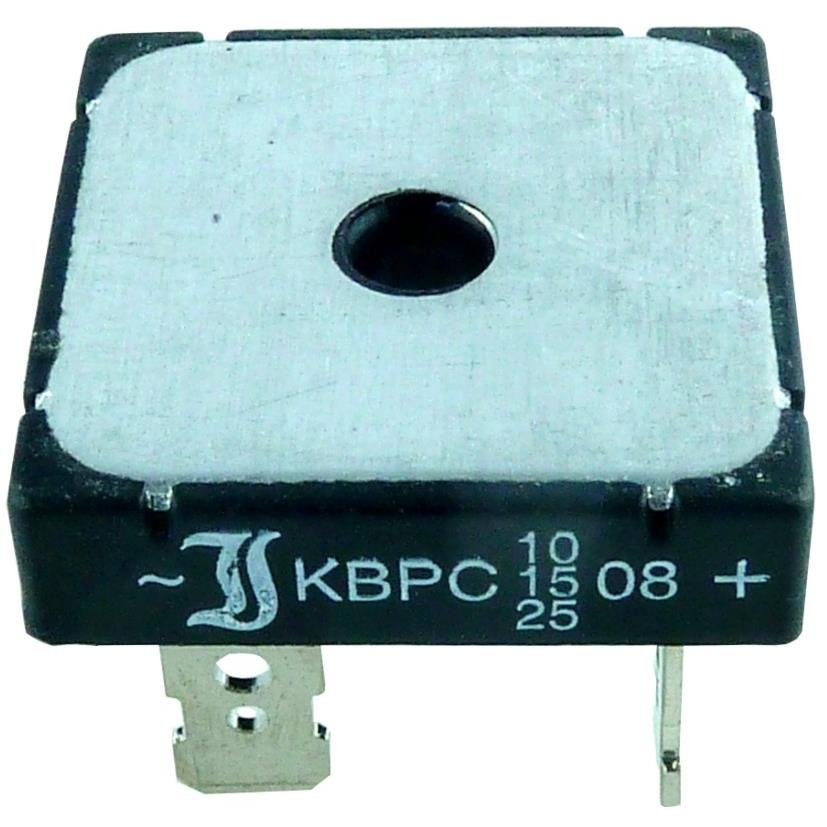
The Diotec Semiconductor KBPC10/15/2508WP is a single-phase silicon bridge rectifier designed for commercial and industrial applications. It features an average forward current (IFAV) of 10 A, 15 A, or 25 A depending on the specific sub-model variant within the series, with a maximum repetitive peak reverse voltage (VRRM) of 800 V. The device utilizes wire terminals (suffix WP) and operates at a maximum junction temperature of 150°C. Key electrical parameters include a typical reverse recovery time (trr) of approximately 1500 ns and a peak forward surge current (IFSM) of 270 A at 50 Hz. The unit is housed in a plastic case with an isolated aluminum baseplate.
Verify the exact current rating (10 A, 15 A, or 25 A) required for the specific application when ordering from the KBPC10/15/2508WP series. Confirm that the wire terminal version meets the mechanical connection needs of the target PCB design. Ensure compliance with local environmental regulations regarding RoHS exemptions and REACH restrictions before finalizing procurement.
Select this component based on the required reverse voltage rating of 800 V and the thermal management capabilities of the heat sink. The choice between 10 A, 15 A, or 25 A variants depends on the continuous load current and case temperature conditions. Verify that the 1500 ns reverse recovery time is acceptable for the operating frequency and that the wire terminal style fits the assembly process constraints.
This part belongs to the KBPC10/15/25 series of single-phase bridge rectifiers from Diotec Semiconductor. The series offers various voltage ratings from 100 V to 1800 V and current ratings up to 25 A. The 'WP' suffix specifically denotes the wire terminal configuration, distinguishing it from the 'FP' fast-on terminal version. These components are standard silicon bridge rectifiers intended for general-purpose rectification tasks.
Direct replacements must match the 800 V VRRM rating and the specific IFAV requirement (10 A, 15 A, or 25 A). Ensure the substitute component also uses wire terminals and has a comparable thermal resistance and reverse recovery time. Cross-reference pinouts and physical dimensions to guarantee compatibility with existing PCB layouts.
 KBPC10/15/2508WP

The activity of extra discounts on wholesale prices is in full swing…
Please fill in your contact information and we will send you the latest wholesale price list.