ChipApex | Global Electronic Components Supplier

SEARCH
Search Product
Search Post
— IC芯片 | 连接器 | 传感器 | 被动器件 —
Search productSearch post
— IC芯片 | 连接器 | 传感器 | 被动器件 —
Consult the customer manager about the wholesale price.
consultation hotline:86-132-6715-2157
email:[email protected]
Contact the product manager for consultation. One-stop consultation is available.
Do you want a lower wholesale price? Please send us your inquiry and we will reply immediately.
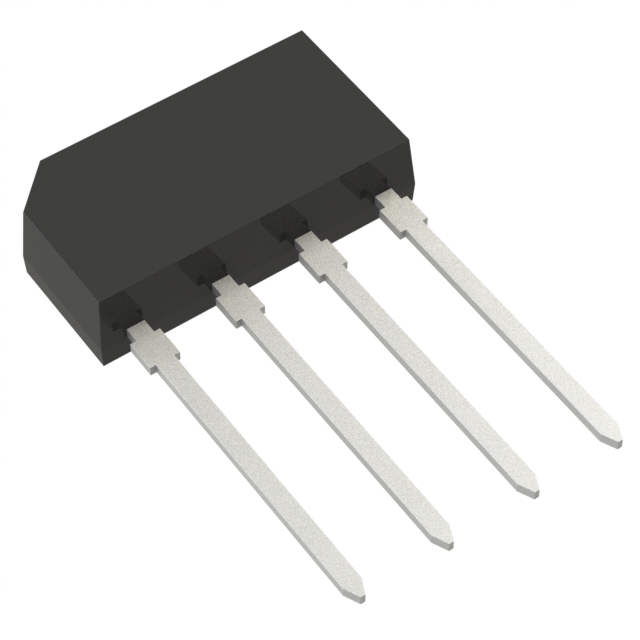
The KBPF404G is a single-phase bridge rectifier manufactured by Taiwan Semiconductor Corporation. It utilizes silicon planar die construction and features glass passivation for junction protection. The device is rated for a maximum average forward rectified current of 4.0 A at an ambient temperature of 130°C. It supports a repetitive peak reverse voltage of 400 V. The component operates within a junction temperature range of -55°C to +150°C and withstands a non-repetitive peak forward surge current of 120 A. It is housed in a compact KBF plastic package with four terminals, designed for through-hole mounting on printed circuit boards.
Verify the manufacturer marking and date code on the component body to confirm authenticity from Taiwan Semiconductor Corporation. Ensure the ordering suffix matches the specific voltage rating and packaging requirements. Cross-reference the datasheet specifications with your design constraints before finalizing procurement to ensure compatibility with your assembly process.
Select this component when a 4 A current rating and 400 V reverse voltage are required in a compact form factor. Consider the KBF package dimensions for PCB layout clearance. Evaluate the thermal management needs based on the 150°C junction temperature limit and the expected ambient operating environment to ensure safe operation margins.
This component belongs to the KBF series of bridge rectifiers from Taiwan Semiconductor Corporation. The series offers various voltage ratings while maintaining a consistent 4 A current capacity and standardized KBF package outline. This family is designed for general-purpose applications where space efficiency and reliable performance are prioritized in power conversion designs.
Compatible substitutes include the KBPF404 from other manufacturers offering identical 4 A and 400 V ratings in the KBF package. Verify that alternative parts meet the same electrical parameters and physical dimensions to ensure direct pin-to-pin replacement without modifying the PCB footprint.
The maximum operating junction temperature is +150°C.
Yes, the device utilizes glass passivation for its junctions to enhance durability and reliability.
The component can withstand a non-repetitive peak forward surge current of 120 A.
 KBPF404G

The activity of extra discounts on wholesale prices is in full swing…
Please fill in your contact information and we will send you the latest wholesale price list.