ChipApex | Global Electronic Components Supplier
SEARCH
Search Product
Search Post
— IC芯片 | 连接器 | 传感器 | 被动器件 —
Search productSearch post
— IC芯片 | 连接器 | 传感器 | 被动器件 —
Consult the customer manager about the wholesale price.
consultation hotline:86-132-6715-2157
email:[email protected]
Contact the product manager for consultation. One-stop consultation is available.
Do you want a lower wholesale price? Please send us your inquiry and we will reply immediately.
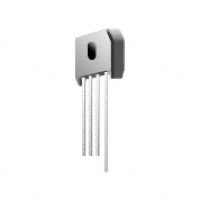
The onsemi KBU4M is a single-phase bridge rectifier designed for general-purpose AC-to-DC conversion. It features an average rectified forward current of 4.0 A at 50°C ambient temperature and supports a maximum repetitive reverse voltage of 1000 V. The device exhibits a typical forward voltage of 1.0 V per bridge at rated current, with a non-repetitive peak forward surge current capability of 200 A. Operating junction temperatures range from -55°C to +150°C, while storage temperatures extend from -55°C to +150°C. Thermal resistance values are specified at 19 °C/W junction-to-ambient and 4.0 °C/W junction-to-lead per leg.
Verify the manufacturer origin carefully, as Fairchild Semiconductor was acquired by onsemi. Confirm the datasheet revision matches your design requirements. Ensure lead lengths and PCB copper pad dimensions align with the thermal performance specifications provided in the documentation. Check for any specific UL recognition file numbers required for end-product certification.
Select the KBU4M when a 1000 V blocking voltage is necessary for high-voltage AC lines. Compare thermal resistance values against other packages if heat dissipation is critical. Consider the 4.0 A continuous current limit relative to the expected load profile and ambient temperature derating curves. Verify that the through-hole GBU-style package fits the mechanical constraints of the target PCB layout.
This component belongs to the KBU series of single-phase bridge rectifiers manufactured by onsemi (formerly Fairchild). The series includes variants with different voltage ratings, such as the KBU4A (50 V) through KBU4K (800 V). The KBU4M represents the highest voltage option in this specific 4 A current rating family, providing robust isolation and reliability for demanding power applications.
Compatible substitutes include the KBU4M from Vishay or ON Semiconductor equivalents with identical pinouts and electrical ratings. Ensure replacement parts maintain the same 1000 V reverse voltage and 4 A forward current capabilities. Verify that the physical dimensions and lead spacing match the original footprint to avoid rework.
 KBU4M
KBU4M
The activity of extra discounts on wholesale prices is in full swing…
Please fill in your contact information and we will send you the latest wholesale price list.