ChipApex | Global Electronic Components Supplier

SEARCH
Search Product
Search Post
— IC芯片 | 连接器 | 传感器 | 被动器件 —
Search productSearch post
— IC芯片 | 连接器 | 传感器 | 被动器件 —
Consult the customer manager about the wholesale price.
consultation hotline:86-132-6715-2157
email:[email protected]
Contact the product manager for consultation. One-stop consultation is available.
Do you want a lower wholesale price? Please send us your inquiry and we will reply immediately.
The LF347DT is a quad wideband JFET operational amplifier manufactured by STMicroelectronics. It features four independent channels in a single SOIC-14 package. Key electrical parameters include a gain-bandwidth product of 4 MHz and a slew rate of 16 V/us. The input bias current is specified at 200 pA, with an input offset voltage of 10 mV. It operates on dual power supplies ranging from -18 V to +18 V, drawing a typical operating supply current of 10.8 mA. The device provides an output current of 60 mA per channel and offers a common-mode rejection ratio of 70 dB.
Verify the specific datasheet revision and parameter tolerances against the official STMicroelectronics documentation before integration. Confirm that the SOIC-14 package dimensions and thermal characteristics align with your PCB layout requirements. Ensure the operating temperature range of 0°C to +70°C meets your environmental specifications. Cross-reference the pinout configuration to prevent installation errors during assembly.
Select this component when a quad amplifier configuration is required alongside high slew rates and low input bias currents. The JFET input stage makes it suitable for applications demanding high input impedance. Consider the 4 MHz bandwidth limit for high-frequency designs. Evaluate the ±18 V maximum supply voltage capability against your system's power rails to ensure adequate headroom for signal swings.
The LF347DT belongs to the LF347 series of monolithic integrated circuits. This family combines well-matched high-voltage J-FETs with bipolar transistors. The design emphasizes low power consumption while maintaining high performance metrics. It serves as a multi-channel solution for systems needing multiple independent amplification paths within a compact surface-mount footprint.
Cross-reference with other manufacturers' quad JFET op-amps such as the TL074 or LM324 variants if pin compatibility is required. Verify that substitute components match the 16 V/us slew rate and 4 MHz bandwidth specifications. Check for equivalent SOIC-14 packaging and identical pin assignments to facilitate direct replacement without circuit redesign.
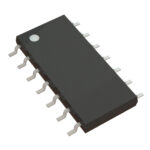 LF347DT

The activity of extra discounts on wholesale prices is in full swing…
Please fill in your contact information and we will send you the latest wholesale price list.