 ChipApex | Global Electronic Components Supplier
SEARCH
Search Product
Search Post
— IC芯片 | 连接器 | 传感器 | 被动器件 —
Search productSearch post
— IC芯片 | 连接器 | 传感器 | 被动器件 —
Consult the customer manager about the wholesale price.
consultation hotline:86-132-6715-2157
email:[email protected]
Contact the product manager for consultation. One-stop consultation is available.
Do you want a lower wholesale price? Please send us your inquiry and we will reply immediately.
The M100PFS-250BAAB is a System on Module (SoM) based on the Microsemi PolarFire SoC FPGA, specifically utilizing the MPFS250T device. This component integrates 254K logic elements and features a hardened RISC-V MPU subsystem comprising four 64-bit RV64GC application cores and one 64-bit RV64IMAC monitor core, all operating at a maximum frequency of 667 MHz. The module includes dedicated memory resources: 2 GB DDR4 RAM for the Hardened Memory Subsystem (HMS) and 512 MB DDR4 RAM for the FPGA fabric. It also incorporates 8 GB eMMC NAND Flash storage and supports various interfaces including dual Gigabit Ethernet, USB 2.0 OTG, and PCIe.
Verify the specific configuration against the datasheet, as the M100PFS series offers variable memory options. The M100PFS-250BAAB model explicitly specifies 2 GB DDR4 for the HMS and 512 MB DDR4 for the FPGA. Confirm that the required storage capacity matches the integrated 8 GB eMMC NAND Flash. Ensure compatibility with the M100PFSEVP baseboard if evaluation or initial development is planned.
Select this module when a mid-range FPGA solution with integrated RISC-V processing is required. The MPFS250T variant provides 254K logic elements, suitable for complex designs needing 16 SERDES lanes and 2 PCIe interfaces. Consider the non-volatile flash-based technology for SEU immunity and lower power consumption compared to SRAM FPGAs. Verify that the 667 MHz clock speed meets the throughput requirements for the intended Linux and real-time applications.
The M100PFS-250BAAB is part of the M100PFS family of System on Modules developed by ARIES Embedded GmbH. These modules are built upon the PolarFire SoC FPGA architecture from Microchip (formerly Microsemi). The family includes variants based on different PolarFire SoC devices, such as the MPFS025T, MPFS095T, MPFS160T, and MPFS250T, allowing designers to scale performance and resource availability based on project needs.
Direct replacement requires matching the PolarFire SoC FPGA package and pinout. Alternative modules from other vendors may require significant hardware redesign due to differences in processor architecture (RISC-V vs. ARM) and FPGA fabric. Evaluate software migration efforts if switching between different RISC-V implementations or FPGA families.



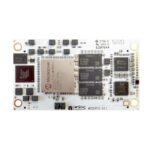 M100PFS-250BAAB
The activity of extra discounts on wholesale prices is in full swing…
Please fill in your contact information and we will send you the latest wholesale price list.



