 ChipApex | Global Electronic Components Supplier

SEARCH
Search Product
Search Post
— IC芯片 | 连接器 | 传感器 | 被动器件 —
Search productSearch post
— IC芯片 | 连接器 | 传感器 | 被动器件 —
Consult the customer manager about the wholesale price.
consultation hotline:86-132-6715-2157
email:[email protected]
Contact the product manager for consultation. One-stop consultation is available.
Do you want a lower wholesale price? Please send us your inquiry and we will reply immediately.
The MAX3073EEPD is a +3.3V, full-duplex RS-422/RS-485 transceiver manufactured by Analog Devices Inc./Maxim Integrated. It integrates one driver and one receiver within a 14-pin PDIP package. The device supports data rates up to 500 kb/s and operates with a fixed supply voltage of 3.3 V. It features ±15 kV ESD protection on the bus pins and includes fail-safe circuitry to ensure a logic-high receiver output when inputs are open or shorted. The component is designed for hot-swap applications and functions reliably across an industrial temperature range from -40°C to +85°C.
Verify the specific suffix 'EEPD' corresponds to the 14-pin PDIP package variant rather than SOIC or TSSOP options. Confirm that the manufacturer designation matches Analog Devices or Maxim Integrated, as legacy branding may vary. Ensure the component meets the required RoHS compliance standards for the intended manufacturing process. Cross-reference the datasheet revision to confirm pinout compatibility with existing designs.
Select this component when a full-duplex interface is required alongside high ESD tolerance and hot-swap capability. The fixed 3.3 V supply requirement limits usage in 5 V systems unless level shifting is implemented. The 500 kb/s data rate is suitable for low-to-medium speed industrial protocols. Consider the PDIP package constraints if surface-mount assembly is preferred for the final product.
This part belongs to the MAX3070E–MAX3079E family of +3.3V RS-422/RS-485 transceivers. These devices share common electrical characteristics, including fail-safe outputs and ±15 kV ESD protection. The primary distinction lies in the package type and thermal performance. This family is widely used in industrial environments where bus reliability under harsh electrical conditions is critical.
The ADM3073EARZ serves as a functional equivalent from Analog Devices, offering similar RS-422/RS-485 capabilities with 15 kV ESD protection. Verify package compatibility, as the ADM3073EARZ typically utilizes an SOIC-14 footprint compared to the PDIP option here. Check for identical pinouts and electrical specifications before substitution.
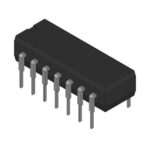 MAX3073EEPD

The activity of extra discounts on wholesale prices is in full swing…
Please fill in your contact information and we will send you the latest wholesale price list.







