 ChipApex | Global Electronic Components Supplier

SEARCH
Search Product
Search Post
— IC芯片 | 连接器 | 传感器 | 被动器件 —
Search productSearch post
— IC芯片 | 连接器 | 传感器 | 被动器件 —
Consult the customer manager about the wholesale price.
consultation hotline:86-132-6715-2157
email:[email protected]
Contact the product manager for consultation. One-stop consultation is available.
Do you want a lower wholesale price? Please send us your inquiry and we will reply immediately.
The MAX3083EPD+ is a high-speed RS-485/RS-422 transceiver manufactured by Analog Devices Inc./Maxim Integrated. It features one driver and one receiver with fail-safe circuitry that guarantees a logic-high receiver output when inputs are open or shorted. The device supports full-duplex communication at data rates up to 500kbps, utilizing slew-rate-limited drivers to minimize EMI and reflections. It operates on a single +5V supply (4.75V to 5.25V) with a typical quiescent current of 375µA. The component provides a 1/8-unit-load receiver input impedance, allowing up to 256 transceivers on the bus, and includes thermal shutdown protection for the driver outputs.
Verify the specific suffix 'E' indicates the extended temperature range (-40°C to +85°C) and 'PD+' denotes the 14-pin plastic DIP package with lead-free composition. Confirm RoHS compliance status directly with the manufacturer documentation. Ensure the ordering code matches the required duplex mode and data rate specifications for your design.
Select this component for applications requiring full-duplex RS-485/RS-422 communication at speeds up to 500kbps. It is suitable for systems needing reduced EMI compared to unrestricted slew-rate devices. Consider the 14-pin PDIP package for through-hole mounting requirements. Verify compatibility with existing bus termination strategies given the 1/8-unit-load input impedance.
This part belongs to the MAX3080–MAX3089 family of fail-safe, high-speed transceivers. While sharing core architecture with siblings like the MAX3080 and MAX3086, the MAX3083 specifically targets the 500kbps performance tier. It differs from the MAX3080 by offering higher slew rates and from the MAX3086 by providing controlled edge rates for better signal integrity at moderate speeds.
The datasheet notes pin-compatibility with industry-standard parts like the 75180. However, verify functional differences such as the additional features implemented via pins 1, 6, 8, and 13. Direct cross-referencing with other manufacturers requires careful comparison of electrical characteristics and pin definitions.
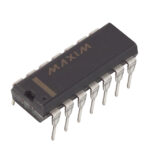 MAX3083EPD+

The activity of extra discounts on wholesale prices is in full swing…
Please fill in your contact information and we will send you the latest wholesale price list.







