 ChipApex | Global Electronic Components Supplier
SEARCH
Search Product
Search Post
— IC芯片 | 连接器 | 传感器 | 被动器件 —
Search productSearch post
— IC芯片 | 连接器 | 传感器 | 被动器件 —
Consult the customer manager about the wholesale price.
consultation hotline:86-132-6715-2157
email:[email protected]
Contact the product manager for consultation. One-stop consultation is available.
Do you want a lower wholesale price? Please send us your inquiry and we will reply immediately.
The MAX3096CEE+ is a quad RS-422/RS-485 receiver manufactured by Analog Devices Inc./Maxim Integrated. It operates from a single +3.3V supply (range 3.135V to 3.6V) and supports data rates up to 10Mbps. The device features ±15kV ESD protection via Human Body Model, ±15kV IEC Air-Gap Discharge, and ±8kV IEC Contact Discharge. It includes complementary enable inputs for a 1nA low-power shutdown mode and guarantees propagation-delay matching within ±10ns across production lots. The component utilizes a 16-pin QSOP package with an operating temperature range of 0°C to +70°C.
Verify the specific ordering suffix against official documentation to confirm package type and temperature rating. Confirm RoHS compliance status as indicated by the '+' symbol in the part number. Ensure the design accommodates the required 3.3V supply voltage range and QSOP footprint dimensions before procurement.
Select this component over the MAX3095 when a +3.3V supply is required instead of +5V. Consider the MAX3096EEE+ variant if operation below 0°C or above +70°C is necessary. Verify that the 10Mbps maximum data rate meets system requirements and that the 16-pin QSOP package fits the available PCB space constraints.
The MAX3096CEE+ belongs to the MAX3095/MAX3096 family of rugged, low-power quad receivers. These devices serve as pin-compatible, low-power upgrades to the industry-standard '26LS32. While the MAX3095 operates at +5V, the MAX3096 is specifically designed for +3.3V applications, maintaining identical functional characteristics and interface compatibility.
The MAX3095CEE+ serves as a direct pin-compatible alternative requiring a +5V supply instead of +3.3V. For extended temperature ranges, the MAX3096EEE+ provides the same electrical specifications but operates between -40°C and +85°C.
The device features a fail-safe mechanism that guarantees a logic-high output when the differential inputs are left open circuit.
Due to its quarter-unit-load input impedance, the MAX3096 allows up to 128 receivers to be connected on the same bus.
Shutdown is initiated by setting the active-high enable input (G) low and the active-low enable input (G) high, reducing supply current to typically less than 1nA.
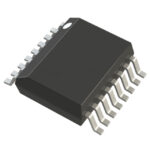 MAX3096CEE
The activity of extra discounts on wholesale prices is in full swing…
Please fill in your contact information and we will send you the latest wholesale price list.





