 ChipApex | Global Electronic Components Supplier
SEARCH
Search Product
Search Post
— IC芯片 | 连接器 | 传感器 | 被动器件 —
Search productSearch post
— IC芯片 | 连接器 | 传感器 | 被动器件 —
Consult the customer manager about the wholesale price.
consultation hotline:86-132-6715-2157
email:[email protected]
Contact the product manager for consultation. One-stop consultation is available.
Do you want a lower wholesale price? Please send us your inquiry and we will reply immediately.
The MAX3098EBEEE is a triple RS-422/RS-485 receiver featuring fault-detection circuitry and independent fault-status outputs. It operates on a single +3V to +5.5V supply with a maximum data rate of 32Mbps. The device provides ±15kV ESD protection via Human Body Model and IEC 1000-4-2 standards. It detects open-circuit, short-circuit, low differential voltage, and common-mode range violations. The part includes a capacitor-programmable delay for the ALARMD output to prevent erroneous alarms at slow edge rates. It is housed in a 16-pin QSOP package and supports an operating temperature range from -40°C to +85°C.
Verify the specific ordering suffix EBEEE against official documentation to confirm the exact package type (QSOP) and industrial temperature range (-40°C to +85°C). Ensure compatibility with system requirements for 16-pin surface-mount installation. Cross-reference the manufacturer's current production status to confirm availability before finalizing procurement plans.
Select this component when high-speed triple reception up to 32Mbps is required alongside comprehensive fault detection capabilities. It is suitable for applications needing extended common-mode input ranges and robust ESD protection without external components. Consider the 16-pin QSOP form factor if board space constraints exist relative to standard industry solutions.
This component belongs to the MAX3097E/MAX3098E family of high-speed receivers designed for motor-shaft encoder applications. The MAX3098 variant specifically features tighter differential fault thresholds compared to the MAX3097. The EBEEE suffix denotes the industrial temperature grade and the 16-pin QSOP package configuration within the broader product line.
MAX3097EBEEE
It relies on a terminating resistor across the inputs. If a wire drops out, the terminating resistor pulls the floating input to match the other, resulting in approximately zero differential voltage, which triggers the fault detection.
The DELAY pin allows connection of an external capacitor to ground to set the propagation delay time for the ALARMD output. This programmable delay prevents false alarms caused by transient faults or slow signal edge rates.
The device supports ±15kV protection using the Human Body Model and ±15kV air-gap discharge method per IEC 1000-4-2, as well as ±8kV contact discharge method per IEC 1000-4-2.
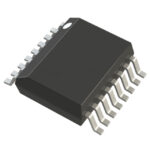 MAX3098EBEEE
The activity of extra discounts on wholesale prices is in full swing…
Please fill in your contact information and we will send you the latest wholesale price list.





