 ChipApex | Global Electronic Components Supplier
SEARCH
Search Product
Search Post
— IC芯片 | 连接器 | 传感器 | 被动器件 —
Search productSearch post
— IC芯片 | 连接器 | 传感器 | 被动器件 —
Consult the customer manager about the wholesale price.
consultation hotline:86-132-6715-2157
email:[email protected]
Contact the product manager for consultation. One-stop consultation is available.
Do you want a lower wholesale price? Please send us your inquiry and we will reply immediately.
The MAX3175CAI is a quad driver/quad receiver multiprotocol transceiver manufactured by Analog Devices Inc./Maxim Integrated. It operates from a single +5V supply and supports software-selectable control for V.28 (RS-232), V.10/V.11, EIA-530, X.21, and RS-423 protocols. The device is housed in a 28-pin SSOP package with an industrial temperature range of 0°C to +70°C. Key electrical characteristics include a maximum operating supply voltage of 5.5V, a minimum of 4.5V, and a typical quiescent current of 0.5mA in shutdown mode. It features true fail-safe operation and includes a 10µs receiver input glitch filter.
Verify the specific suffix 'CAI' corresponds to the commercial temperature grade and SSOP package variant required for your design. Confirm RoHS compliance status as indicated by the '+' suffix if applicable to your manufacturing standards. Check current availability through authorized distributors as lead times may vary. Ensure the single +5V supply requirement aligns with your system power architecture before procurement.
Select this component when a single chip solution is needed for mixed-protocol serial communication ports requiring software configurability. Compare against the MXL1544 for pin compatibility within the same chipset family. Consider the MAX3173 or MAX3171 if lower voltage operation (3.3V) or fewer drivers/receivers are sufficient for the application requirements.
The MAX3175 belongs to the Maxim Integrated multiprotocol transceiver family designed for data terminal equipment (DTE) and data communications equipment (DCE) interfaces. It is part of a chipset that typically pairs with clock/data transceivers like the MXL1543 to form complete serial port solutions. This series is engineered to replace discrete logic implementations in legacy serial interface designs.
MXL1544 is a pin-compatible alternative within the same product family offering identical functionality.
The 10µs receiver input glitch filter suppresses short-duration noise pulses on the receive line, preventing false triggering of the output state.
Protocol selection is software-controlled via dedicated control pins, allowing the same hardware to support V.28, V.10/V.11, EIA-530, X.21, and RS-423 standards.
True fail-safe operation ensures that if the receiver inputs are left open or disconnected, the receiver outputs default to a high logic state, preventing erroneous data interpretation.
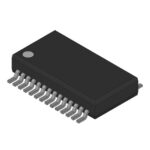 MAX3175CAI
The activity of extra discounts on wholesale prices is in full swing…
Please fill in your contact information and we will send you the latest wholesale price list.





