 ChipApex | Global Electronic Components Supplier
SEARCH
Search Product
Search Post
— IC芯片 | 连接器 | 传感器 | 被动器件 —
Search productSearch post
— IC芯片 | 连接器 | 传感器 | 被动器件 —
Consult the customer manager about the wholesale price.
consultation hotline:86-132-6715-2157
email:[email protected]
Contact the product manager for consultation. One-stop consultation is available.
Do you want a lower wholesale price? Please send us your inquiry and we will reply immediately.
The MAX3241CWI+ is a true RS-232 transceiver operating from a single 3.0V to 5.5V supply. It features three drivers and five receivers, utilizing a dual charge pump with four 0.1µF external capacitors. The device guarantees data rates up to 120kbps, typically reaching 235kbps. It includes shutdown functionality reducing supply current to less than 1µA. Two complementary receiver outputs (R1OUTB, R2OUTB) remain active during shutdown for ring indicator applications. The component operates within a commercial temperature range of 0°C to +70°C and is housed in a 28-pin Wide SOIC package.
Verify the specific suffix 'W' corresponds to the 28-pin Wide SOIC package and the 'C' indicates the 0°C to +70°C temperature grade. Confirm RoHS compliance status through official manufacturer documentation or authorized distributors before finalizing procurement specifications.
Select this component when interfacing TTL/CMOS logic with RS-232 ports requiring multiple transmitter and receiver channels. Ensure the application environment remains within the specified 0°C to +70°C operational limits. Verify that the required data rate does not exceed the guaranteed 120kbps threshold under worst-case loading conditions.
This part belongs to the MAX32xx family of low-power, true RS-232 transceivers designed for single-supply operation. It shares architectural similarities with the MAX3222 and MAX3232 but provides additional driver and receiver channels. The MAX3241 is specifically optimized for applications requiring extensive serial connectivity and peripheral monitoring capabilities.
MAX3241CAI+ (SSOP package)
The R1OUTB and R2OUTB pins remain always active regardless of the EN or SHDN states, allowing detection of RS-232 activity even when the main receiver outputs are disabled.
The MAX3241 is guaranteed to operate at data rates of 120kbps while maintaining true RS-232 output levels. Typical performance reaches 235kbps.
Yes, the device has been tested with leading mouse brands and successfully meets their respective current and voltage requirements from low-voltage power supplies.
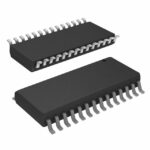 MAX3241CWI
The activity of extra discounts on wholesale prices is in full swing…
Please fill in your contact information and we will send you the latest wholesale price list.





