 ChipApex | Global Electronic Components Supplier
SEARCH
Search Product
Search Post
— IC芯片 | 连接器 | 传感器 | 被动器件 —
Search productSearch post
— IC芯片 | 连接器 | 传感器 | 被动器件 —
Consult the customer manager about the wholesale price.
consultation hotline:86-132-6715-2157
email:[email protected]
Contact the product manager for consultation. One-stop consultation is available.
Do you want a lower wholesale price? Please send us your inquiry and we will reply immediately.
The MAX3362EKA#TG15 is a low-power, high-speed RS-485/RS-422 transceiver operating from a single +3.3V supply (3.135V to 3.465V). It features one differential driver and receiver with data rates up to 20Mbps. Driver and receiver propagation delays are guaranteed below 50ns, with output skew under 6ns. The device draws 1.7mA in normal operation and 1µA in shutdown mode. It supports half-duplex communication, includes hot-swap capability, and operates within an extended temperature range of -40°C to +85°C in an 8-pin SOT package.
Verify the specific suffix #TG15 against official manufacturer documentation to confirm exact packaging and RoHS compliance status. Confirm availability as this variant may be subject to production changes or end-of-life notices. Cross-reference the ordering information table for accurate lead times and current part status before finalizing procurement plans.
Select this component for applications requiring high-speed RS-485/RS-422 communication with low power consumption. Ensure the system voltage aligns with the +3.3V requirement. Consider the automotive temperature range variant if operating conditions exceed standard industrial limits. Verify that the 8-pin SOT package fits the available PCB space constraints.
The MAX3362 belongs to Maxim Integrated's family of high-speed, low-power transceivers designed for multidrop networks. It complements other RS-485/RS-422 solutions by offering reduced unit load and enhanced protection features. The EKA suffix typically denotes the extended temperature range variant within this product line.
MAX3362AKA+T: Automotive temperature range (-40°C to +125°C) variant.
An internal pulldown circuit holds the DE input low for at least 10µs upon power-up, preventing false driver enable states caused by leakage currents or parasitic capacitance during board insertion.
The MAX3362 has a 1/8-unit-load receiver input impedance, allowing up to 256 transceivers to be connected simultaneously on a single bus.
Shutdown mode is initiated by driving the Receiver Enable (RE) pin high and the Driver Enable (DE) pin low simultaneously for at least 600ns.
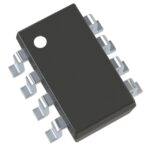 MAX3362EKA#TG15
The activity of extra discounts on wholesale prices is in full swing…
Please fill in your contact information and we will send you the latest wholesale price list.





