 ChipApex | Global Electronic Components Supplier
SEARCH
Search Product
Search Post
— IC芯片 | 连接器 | 传感器 | 被动器件 —
Search productSearch post
— IC芯片 | 连接器 | 传感器 | 被动器件 —
Consult the customer manager about the wholesale price.
consultation hotline:86-132-6715-2157
email:[email protected]
Contact the product manager for consultation. One-stop consultation is available.
Do you want a lower wholesale price? Please send us your inquiry and we will reply immediately.
The MAX3490AEGSA+T is a full-duplex RS-485/RS-422 transceiver operating from a single 3.3V supply (3.0V to 3.6V). It supports data rates up to 20Mbps with driver propagation delays of 30ns and receiver delays of 35ns. The device features ±20kV HBM ESD protection on A, B, Y, and Z pins, and includes fail-safe receivers that ensure a logic-high output when inputs are open or shorted. It accommodates up to 128 transceivers on the bus due to its 1/4-unit load input impedance. Operating temperatures range from -40°C to +125°C.
Verify the specific suffix 'T' indicates tape-and-reel packaging configuration. Confirm the 'E' designation corresponds to the extended temperature range of -40°C to +125°C. Ensure the component matches the 8-pin SO package dimensions and pinout defined in the official datasheet before integration into the bill of materials.
Select this model for full-duplex communication requirements where high-speed data transmission up to 20Mbps is necessary. The 1/4-unit load impedance allows for larger network topologies supporting up to 128 nodes. Verify compatibility with 3.3V logic interfaces and ensure the application environment falls within the specified extended industrial temperature limits.
This component belongs to the MAX3483AE/MAX3491AE family of low-power transceivers. It shares architectural similarities with half-duplex variants like the MAX3485AE but provides independent transmit and receive channels. The device utilizes industry-standard pinouts compatible with legacy designs while offering improved robustness through integrated protection circuits.
MAX3490ESA+
The device incorporates internal circuitry that holds the Driver Enable (DE) low and Receiver Enable (RE) high during initial power-up. This prevents unintended bus activation until the system stabilizes, typically after a 10µs delay.
The receiver ensures a logic-high output at RO when the differential input voltage (VA - VB) is greater than or equal to -10mV. This condition occurs if the inputs are open, shorted, or connected to a terminated line with all drivers disabled.
Yes, the driver outputs can operate in standard differential mode or as single-ended TTL-compatible outputs. They swing rail-to-rail, allowing individual use as standard logic outputs.
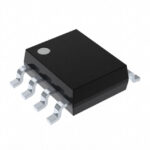 MAX3490AEGSA+T
The activity of extra discounts on wholesale prices is in full swing…
Please fill in your contact information and we will send you the latest wholesale price list.





