 ChipApex | Global Electronic Components Supplier
SEARCH
Search Product
Search Post
— IC芯片 | 连接器 | 传感器 | 被动器件 —
Search productSearch post
— IC芯片 | 连接器 | 传感器 | 被动器件 —
Consult the customer manager about the wholesale price.
consultation hotline:86-132-6715-2157
email:[email protected]
Contact the product manager for consultation. One-stop consultation is available.
Do you want a lower wholesale price? Please send us your inquiry and we will reply immediately.
The MAX483CSA+T is a low-power, half-duplex RS-485 and RS-422 transceiver manufactured by Analog Devices Inc. (Maxim Integrated). It integrates one driver and one receiver within an 8-pin SOIC package. The device supports data rates up to 250kbps with slew-rate-limited drivers to minimize electromagnetic interference. It operates from a single 5V supply, drawing 120µA in active mode and 0.1µA in shutdown. Key electrical parameters include a differential output voltage of 2.5V typical, a receiver input hysteresis of 70mV, and a common-mode input range of -7V to +12V.
Verify the component origin through official manufacturer channels or authorized distributors. Confirm that the ordering suffix matches the required temperature range and package type. Ensure compliance with RoHS directives as indicated by the plus sign in the part number. Request original datasheets to validate specifications against counterfeit risks before finalizing procurement decisions.
Select this component for half-duplex applications requiring data rates up to 250kbps. The slew-rate limitation makes it suitable for environments where electromagnetic interference must be minimized. Compare quiescent current requirements against other models in the series to ensure compatibility with low-power system designs. Verify that the 5V supply voltage aligns with the target system architecture.
This device belongs to the MAX48x family of low-power transceivers designed for RS-485 and RS-422 standards. It shares architectural similarities with the MAX481 and MAX485 but differs in its maximum data rate specification. The family provides various options for full-duplex operation and higher speed capabilities, positioning this specific model as a cost-effective solution for moderate-speed industrial communication buses.
MAX483ESA+T: Industrial temperature grade (-40°C to +85°C) version of the same functional device.
The receiver includes a fail-safe feature that guarantees a logic-high output state if the A and B input pins are left open circuit.
Shutdown is initiated by driving the Receiver Enable (RE) pin high and the Driver Enable (DE) pin low simultaneously for at least 600ns.
The limited slew rate minimizes electromagnetic interference (EMI) and reduces signal reflections caused by improperly terminated cables.
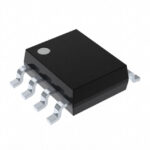 MAX483CSA+T
The activity of extra discounts on wholesale prices is in full swing…
Please fill in your contact information and we will send you the latest wholesale price list.





