ChipApex | Global Electronic Components Supplier

SEARCH
Search Product
Search Post
— IC芯片 | 连接器 | 传感器 | 被动器件 —
Search productSearch post
— IC芯片 | 连接器 | 传感器 | 被动器件 —
Consult the customer manager about the wholesale price.
consultation hotline:86-132-6715-2157
email:[email protected]
Contact the product manager for consultation. One-stop consultation is available.
Do you want a lower wholesale price? Please send us your inquiry and we will reply immediately.
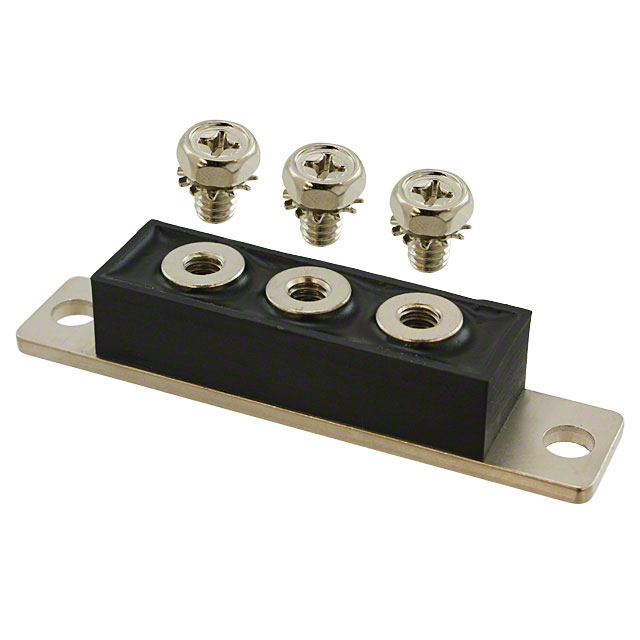
The MBRTA40040L is a low forward voltage silicon power Schottky diode manufactured by GeneSiC Semiconductor. It features a Twin Tower package configuration with two elements in a common anode arrangement. The device supports a repetitive peak reverse voltage of 40V and an average forward current of 200A per element, with a maximum non-repetitive peak forward surge current of 3000A. Key electrical parameters include a maximum DC blocking voltage of 40V and a maximum forward voltage of 0.65V at specified conditions. The component operates within a junction temperature range of -55°C to 175°C.
Verify the specific suffix 'L' against official GeneSiC documentation to confirm lead configuration or variant specifics, as standard part numbers may differ. Ensure the procurement channel provides valid RoHS compliance certificates. Cross-reference the package marking with the datasheet to prevent counterfeit components. Confirm thermal management requirements align with the Twin Tower package specifications before finalizing orders.
Select this component for applications requiring high current handling with minimal conduction losses. The 40V rating suits low-voltage DC systems. Consider the common anode topology for synchronous rectification or bridge configurations. Evaluate thermal resistance characteristics against the system's heat dissipation capabilities. Compare the forward voltage drop against alternative Schottky diodes to optimize overall system efficiency.
This part belongs to the GeneSiC Silicon Power Schottky Diode family, designed for high-efficiency power conversion. It utilizes a Twin Tower package to provide reliable isolation and mounting options. The series offers various voltage ratings from 20V to 100V, maintaining consistent current handling capabilities across the lineup for scalable power design solutions.
Consult official cross-reference guides for compatible alternatives. Verify that substitute parts match the 40V reverse voltage, 200A current rating, and common anode configuration. Ensure physical package dimensions and terminal compatibility are identical to maintain board layout integrity.
 MBRTA40040L

The activity of extra discounts on wholesale prices is in full swing…
Please fill in your contact information and we will send you the latest wholesale price list.