ChipApex | Global Electronic Components Supplier

SEARCH
Search Product
Search Post
Search productSearch post
Consult the customer manager about the wholesale price.
consultation hotline:86-132-6715-2157
email:[email protected]
Contact the product manager for consultation. One-stop consultation is available.
Do you want a lower wholesale price? Please send us your inquiry and we will reply immediately.
MCP6V16UT-E/LTY is listed in the Instrumentation, Op Amps, Buffer Amps range at ChipApex. The manufacturer field lists Microchip Technology. Its product description is IC OPAMP ZERO-DRIFT 1CIRC SC70-5. Review the specifications below when checking this part for your BOM.
The MCP6V16UT-E/LTY is a single-channel zero-drift operational amplifier from Microchip Technology, housed in an SC-70-5 package. It features a typical gain bandwidth product of 80 kHz and a quiescent current of 7.5 µA per amplifier. The device operates on supply voltages ranging from 1.6 V to 5.5 V with rail-to-rail input and output capabilities. Key electrical specifications include a maximum input offset voltage of ±25 µV at 25°C, a maximum input offset voltage drift of ±150 nV/°C across the temperature range, and a typical input bias current of 5 pA.
Verify the specific ordering suffix 'E/LTY' against the manufacturer's official documentation to confirm the exact package type (SC-70-5) and temperature grade. Ensure compatibility with the required PCB footprint and soldering profile for surface-mount assembly. Cross-reference the datasheet revision date to confirm electrical parameter validity for production integration.
Select this component when high DC precision and low offset drift are critical requirements alongside minimal power consumption. The 80 kHz bandwidth suits low-frequency signal processing tasks. Consider the SC-70-5 package size constraints and verify that the 1.6 V minimum supply voltage aligns with the system power rails. Evaluate thermal performance if operating near the upper temperature limits.
This device belongs to the MCP6V16/6U/7/9 family of zero-drift operational amplifiers manufactured using an advanced CMOS process. The family includes single, dual, and quad configurations, offering flexibility in channel count while maintaining consistent electrical characteristics such as low noise and high common-mode rejection ratios across the extended industrial temperature range.
Consult the datasheet related parts section for alternatives like the MCP6V01 or MCP6V06 series which share similar auto-zeroed architectures but may differ in noise or speed specifications. Verify pinout compatibility and electrical parameter overlaps before substituting to ensure circuit functionality remains intact without redesign.
The internal oscillator runs at 50 kHz, which is divided by two to produce a chopping clock rate of 25 kHz.
No, the device is designed to show no input phase reversal even when subjected to overdrive conditions.
Explore related parts through Amplifiers, Linear, Integrated Circuits (ICs), all product categories.
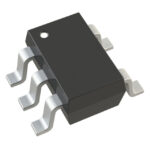 MCP6V16UT-E/LTY

The activity of extra discounts on wholesale prices is in full swing…
Please fill in your contact information and we will send you the latest wholesale price list.