ChipApex | Global Electronic Components Supplier
SEARCH
Search Product
Search Post
— IC芯片 | 连接器 | 传感器 | 被动器件 —
Search productSearch post
— IC芯片 | 连接器 | 传感器 | 被动器件 —
Consult the customer manager about the wholesale price.
consultation hotline:86-132-6715-2157
email:[email protected]
Contact the product manager for consultation. One-stop consultation is available.
Do you want a lower wholesale price? Please send us your inquiry and we will reply immediately.
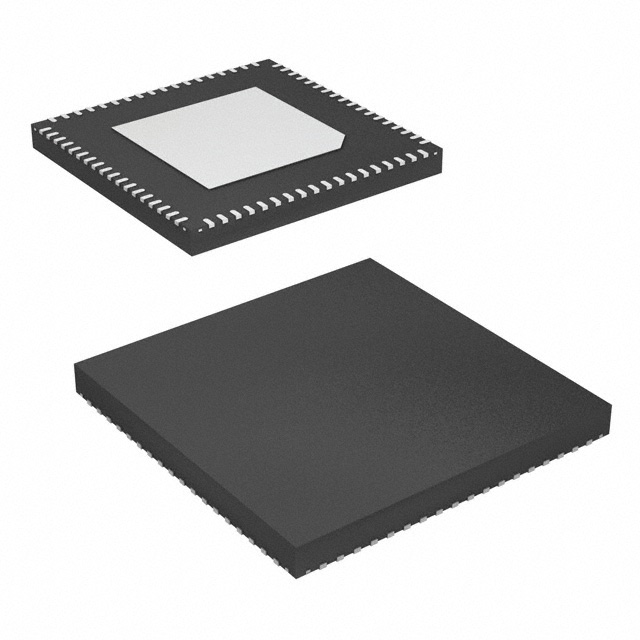
The MDB1900ZBQY-TR is a zero-delay clock buffer manufactured by Microchip Technology, originally designed by Micrel. It features a fully integrated programmable PLL for distributing reference clocks in PCIe (Gen1/Gen2/Gen3), SATA, SAS, ESI, and Intel QPI systems. The device accepts differential HCSL input and provides 19 differential HCSL-compatible outputs with a 2:19 ratio. It operates on a 2.375V to 3.465V supply within the -40°C to +85°C temperature range. Key electrical parameters include cycle-to-cycle jitter under 35ps in PLL mode, output-to-output skew under 35ps, and an input-to-output delay variation of 13ps.
Verify component authenticity as this part was originally manufactured by Micrel before acquisition by Microchip. Confirm the 'QY' suffix indicates the industrial temperature grade (-40°C to +85°C). Check current availability status, as the product may be discontinued or subject to long lead times due to its age. Ensure the package matches the 72-pin 10mm x 10mm QFN specification.
Select this component when designing systems requiring low-jitter clock distribution for high-speed serial interfaces like PCIe Gen3 or QPI. Ensure the design accommodates the specific external feedback resistor values (e.g., 33Ω series, 49.9Ω shunt for 100Ω impedance) required for zero-delay operation. Verify that the host controller supports the HCSL logic levels and that the SMBus address configuration allows for multiple devices on the same bus if needed.
This component corresponds to the Micrel MDB1900ZB, identified by Intel as G20746-002. It is designed to meet Intel's DB1900Z specification. The 'MDB1900ZBQY-TR' designation specifically denotes the tape and reel shipping format for the industrial temperature variant. It belongs to the broader category of application-specific clock and timing buffers used in complex digital systems.
Publicly confirmed substitute part numbers are not available in the provided documentation. Designers should consult Microchip's official portfolio for newer clock buffer alternatives or verify pin-to-pin compatibility with other zero-delay buffers if sourcing the original Micrel part is not feasible.
Zero-delay operation is achieved through an external feedback path connecting the FB_OUT/FB_IN pins. This topology minimizes input-to-output delay variation, which is specified at 13ps in PLL mode.
For a 100Ω trace impedance, use a 33Ω series resistor and a 49.9Ω shunt resistor. For an 85Ω trace impedance, use a 27Ω series resistor and a 42.2Ω shunt resistor. These should be placed close to the FB_OUT pins.
Yes, the MDB1900ZB is tolerant of spread spectrum modulation for EMI reduction. It supports modulation frequencies between 30kHz and 33kHz with triangular or Lexmark profiles.
 MDB1900ZBQY-TR
The activity of extra discounts on wholesale prices is in full swing…
Please fill in your contact information and we will send you the latest wholesale price list.