 ChipApex | Global Electronic Components Supplier

SEARCH
Search Product
Search Post
— IC芯片 | 连接器 | 传感器 | 被动器件 —
Search productSearch post
— IC芯片 | 连接器 | 传感器 | 被动器件 —
Consult the customer manager about the wholesale price.
consultation hotline:86-132-6715-2157
email:[email protected]
Contact the product manager for consultation. One-stop consultation is available.
Do you want a lower wholesale price? Please send us your inquiry and we will reply immediately.
The MM74HC4046MTC is a CMOS Phase Lock Loop (PLL) integrated circuit manufactured by onsemi, housed in a 16-lead Thin Shrink Small Outline Package (TSSOP). It operates within a supply voltage range of 2 V to 6 V and supports an operating temperature range of -40°C to +85°C. The device integrates a low-power linear Voltage Controlled Oscillator (VCO), a source follower, and three distinct phase comparators: an Exclusive OR gate (Comparator I), an edge-sensitive digital sequential network (Comparator II), and an SR flip-flop (Comparator III). At 4.5 V, the maximum VCO frequency reaches 12 MHz with comparator response times between 25 ns and 30 ns.
Verify the package designation MTC16 corresponds to the required 16-lead TSSOP form factor. Confirm that the -40°C to +85°C commercial temperature range meets system requirements, as industrial variants may differ. Ensure design accounts for the 2 V to 6 V supply voltage limits and power dissipation derating factors specified in the datasheet.
Select this component when a single-chip PLL solution with multiple comparator options is needed. Comparator I offers better noise rejection but risks harmonic locking; Comparator II provides zero phase shift lock but is more noise-sensitive. Comparator III functions similarly to Comparator II but requires short pulse inputs. Choose based on whether duty cycle independence or harmonic immunity is prioritized.
This part belongs to the MM74HC4046 family, which includes variants such as the SOIC (MM74HC4046M), SOP (MM74HC4046SJ), and PDIP (MM74HC4046N). The MM74HC4046MTC specifically denotes the TSSOP package variant. It serves as a high-speed CMOS alternative to older metal-gate CD4046 devices, replacing internal Zener diodes with an additional phase comparator.
Pin-compatible alternatives include the CD74HC4046A from Texas Instruments and the 74HC4046AD from Nexperia. Verify electrical specifications such as propagation delay and VCO linearity against the original design requirements before substitution.
The self-biasing amplifier allows signals to be either capacitively coupled with small signal amplitudes or directly coupled with standard logic levels, simplifying interface design.
Phase Comparator I is an XOR gate sensitive to duty cycle and susceptible to harmonic locking, while Phase Comparator II is edge-sensitive, independent of duty cycle, and locks with zero phase shift.
The VCO center frequency is set by two external components, R1 and C1, connected to pins 1, 2, and 3. Resistor R1 also controls the lock range.
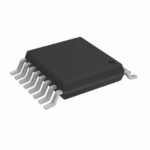 MM74HC4046MTC

The activity of extra discounts on wholesale prices is in full swing…
Please fill in your contact information and we will send you the latest wholesale price list.





