ChipApex | Global Electronic Components Supplier
SEARCH
Search Product
Search Post
— IC芯片 | 连接器 | 传感器 | 被动器件 —
Search productSearch post
— IC芯片 | 连接器 | 传感器 | 被动器件 —
Consult the customer manager about the wholesale price.
consultation hotline:86-132-6715-2157
email:[email protected]
Contact the product manager for consultation. One-stop consultation is available.
Do you want a lower wholesale price? Please send us your inquiry and we will reply immediately.
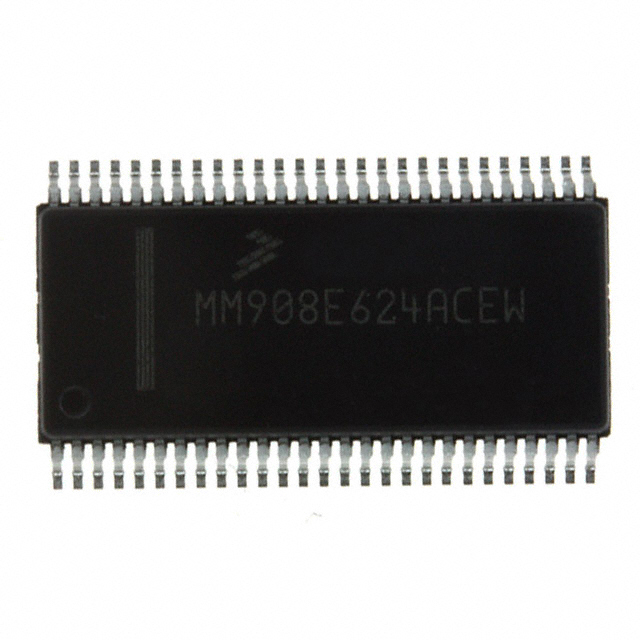
The MM908E624ACEW is an integrated single-package solution combining a high-performance HC08 microcontroller with a SMARTMOS analog control IC. It features three high-side outputs, a LIN physical layer interface, and diagnostic functions for automotive relay drivers. The MCU includes 16 KB of flash memory, 512 bytes of RAM, a 10-bit ADC, and two 16-bit timers. The analog die provides a low dropout voltage regulator, current sense operational amplifier, and window watchdog. Operating temperatures range from -40°C to 85°C (ACPEW) or -40°C to 125°C (AYPEW).
Verify the specific suffix (e.g., ACPEW vs AYPEW) to confirm the operating temperature range (-40°C to 85°C or -40°C to 125°C). Confirm package type (54 SOICW) and ensure compatibility with existing PCB footprints. Check for RoHS compliance status as per manufacturer documentation.
Select based on required thermal performance; choose AYPEW for extended temperature environments up to 125°C. Ensure supply voltage requirements (5.5V to 18V nominal) align with system design. Verify that the 16 I/O pins and specific peripheral interfaces (SPI, ESCI, ADC) meet application logic needs.
This component belongs to the NXP 908E series, designed for body electronics. It integrates digital control and power switching in one package to reduce BOM count and PCB area. It replaces discrete MCU and driver solutions in automotive relay and motor control modules.
Check form, fit, and function compatibility with existing designs. Verify pinout alignment if substituting similar parts. Note that ordering suffixes like R2 indicate tape and reel packaging, which may affect handling but not electrical function.
The nominal operating voltage range is 5.5 V to 18 V. The device can withstand transient voltages up to 27 V under steady-state conditions.
The watchdog period is configured using an external resistor connected to the WDCONF pin. The period accuracy depends on the resistor value and tolerance.
Yes, it supports wake-up via LIN bus dominant signal detection or through dedicated wake-up inputs L1 and L2.
 MM908E624ACEW
The activity of extra discounts on wholesale prices is in full swing…
Please fill in your contact information and we will send you the latest wholesale price list.