ChipApex | Global Electronic Components Supplier
SEARCH
Search Product
Search Post
— IC芯片 | 连接器 | 传感器 | 被动器件 —
Search productSearch post
— IC芯片 | 连接器 | 传感器 | 被动器件 —
Consult the customer manager about the wholesale price.
consultation hotline:86-132-6715-2157
email:[email protected]
Contact the product manager for consultation. One-stop consultation is available.
Do you want a lower wholesale price? Please send us your inquiry and we will reply immediately.
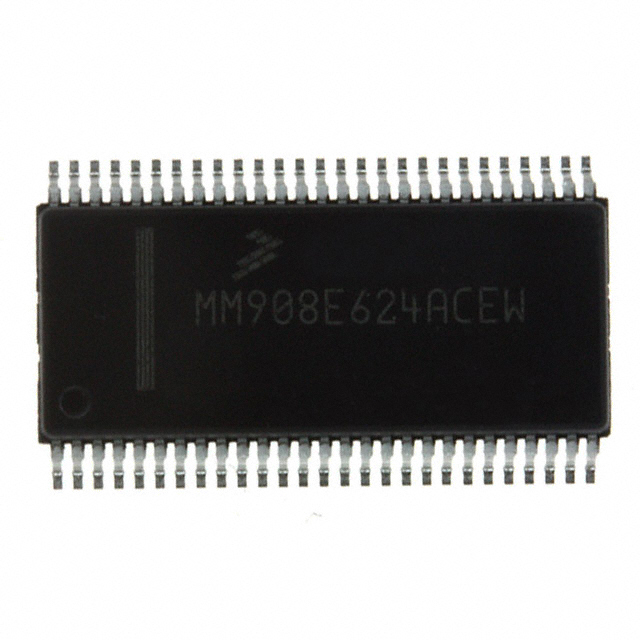
The MM908E624ACEWR2 is an integrated single-package solution combining a high-performance HC08 microcontroller with a SMARTMOS analog control IC. It features the M68HC908EY16 core, 16 KB of on-chip flash memory, and 512 bytes of RAM. The analog die provides three high-side outputs with diagnostic functions, a voltage regulator, watchdog timer, current sense operational amplifier, and LIN physical layer interface. Operating within a supply voltage range of 5.5 V to 18 V, it supports automotive applications such as window lifts, fans, and sun roofs.
Verify the R2 suffix indicates tape and reel packaging. Confirm the ACPEW variant corresponds to the -40°C to 85°C operating temperature range. Check RoHS compliance status and ensure the component meets AEC-Q100 requirements if applicable to the specific design constraints.
Select this device for applications requiring a combined MCU and power switch in a compact form factor. Ensure the load current does not exceed the 300 mA limit for HS1/HS2 or 100 mA for HS3. Verify that the external resistor on the WDCONF pin correctly sets the watchdog period according to the specified formula.
This part belongs to the NXP 908E series of automotive microcontrollers. It integrates digital control logic with analog power management, reducing bill-of-materials complexity compared to discrete solutions. The device is designed specifically for body electronics where space saving and system reliability are critical.
Check for direct cross-reference availability from NXP distributors. Consider the MM908E622 or MM908E625 only if pin compatibility and functional differences (such as H-Bridge vs High-Side configurations) align with the existing hardware design.
The maximum operating junction temperature is 125°C for both the ACPEW (-40 to 85°C ambient) and AYPEW (-40 to 125°C ambient) variants.
The watchdog period is configured using an external resistor connected to the WDCONF pin. The period accuracy is ±15% excluding resistor tolerance.
L1 and L2 serve as wake-up inputs for the analog chip, allowing the device to exit sleep mode upon detecting specific voltage thresholds.
 MM908E624ACEWR2
The activity of extra discounts on wholesale prices is in full swing…
Please fill in your contact information and we will send you the latest wholesale price list.