 ChipApex | Global Electronic Components Supplier

SEARCH
Search Product
Search Post
— IC芯片 | 连接器 | 传感器 | 被动器件 —
Search productSearch post
— IC芯片 | 连接器 | 传感器 | 被动器件 —
Consult the customer manager about the wholesale price.
consultation hotline:86-132-6715-2157
email:[email protected]
Contact the product manager for consultation. One-stop consultation is available.
Do you want a lower wholesale price? Please send us your inquiry and we will reply immediately.
The MMBTRA101SS is a surface-mount digital PNP transistor manufactured by Diotec Semiconductor, housed in an SOT-23 (TO-236) package. It integrates bias resistors to simplify circuit design. Key electrical parameters include a maximum output voltage of -50 V and a continuous output current of -100 mA. The device dissipates up to 200 mW of power and operates within a junction temperature range of -55°C to +150°C. Internal resistor values are typically 4.7 kΩ for both R1 and R2, with a resistance ratio between 0.8 and 1.2. The transition frequency is typically 200 MHz, and the DC current gain is specified at a minimum of 30 under standard test conditions.
Verify the specific ordering suffix when purchasing. The base model represents commercial grade components suitable for standard industrial use. Suffixes such as -Q indicate AEC-Q101 compliance, while -AQ denotes parts undergoing automotive qualification. Confirm that the required reliability grade matches the application environment before finalizing orders.
Select this component for designs requiring a pre-biased PNP transistor in a compact SOT-23 footprint. Ensure the input voltage limits align with the logic levels used in the driving circuitry. Consider the thermal dissipation capabilities relative to the copper pad area on the PCB, as power ratings depend on adequate heat sinking through the solder joints.
This part belongs to the MMBTRA series of SMD digital transistors from Diotec Semiconductor. The series includes complementary NPN variants and other resistor configurations. These devices are designed to replace discrete transistor-resistor networks, offering a standardized solution for interface and buffering tasks in consumer electronics and general-purpose equipment.
Direct substitutes within the same family include MMBTRA102SS through MMBTRA106SS, which feature different internal resistor ratios. Cross-manufacturer equivalents should be verified against the specific pinout, voltage ratings, and integrated resistance values to ensure functional compatibility.
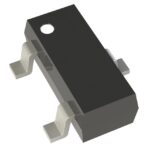 MMBTRA101SS

The activity of extra discounts on wholesale prices is in full swing…
Please fill in your contact information and we will send you the latest wholesale price list.





