 ChipApex | Global Electronic Components Supplier
SEARCH
Search Product
Search Post
— IC芯片 | 连接器 | 传感器 | 被动器件 —
Search productSearch post
— IC芯片 | 连接器 | 传感器 | 被动器件 —
Consult the customer manager about the wholesale price.
consultation hotline:86-132-6715-2157
email:[email protected]
Contact the product manager for consultation. One-stop consultation is available.
Do you want a lower wholesale price? Please send us your inquiry and we will reply immediately.
The MMBV2108LT1 is a silicon tuning diode from the MMBV2101LT1 series, designed for FM radio and TV tuning applications. It operates in an SOT-23 package with a maximum reverse voltage of 30 Vdc and forward current of 200 mAdc. The device provides a typical diode capacitance of 27 pF at 4.0 Vdc (range: 24.3–29.7 pF) and a minimum figure of merit of 300 at 50 MHz. Its tuning ratio ranges from 2.5 to 3.2, measured between 2.0 Vdc and 30 Vdc. The component supports junction temperatures up to +150°C and storage temperatures from -55°C to +150°C.
Verify the specific ordering suffix when purchasing. The 'T1' suffix indicates tape and reel packaging, while dropping it denotes bulk availability. Confirm Pb-free status by checking for the 'G' suffix or microdot marking on the component body. Ensure the requested part matches the exact series designation to guarantee correct electrical characteristics.
Select this component based on required capacitance values and operating frequencies. Verify that the 30 Vdc reverse voltage rating meets the circuit's peak reverse bias requirements. Consider the thermal derating specifications if the ambient temperature exceeds 25°C. Compare the figure of merit against other series members to ensure adequate quality factor for the intended application.
This device belongs to the MMBV2101LT1 series, which includes variants like MMBV2101LT1, MMBV2105LT1, and MMBV2109LT1. These parts share similar structural designs but differ in nominal capacitance values ranging from approximately 6.8 pF to 36.3 pF. The series is engineered for high-volume manufacturing and offers plastic package options suitable for surface mount and through-hole technologies.
MMBV2109LT1
The tuning ratio is defined as the ratio of diode capacitance measured at 2.0 Vdc divided by the capacitance measured at 30 Vdc.
Pin 1 is the Anode, Pin 2 is No Connection, and Pin 3 is the Cathode.
Q is calculated using G and C readings from an admittance bridge at the specified frequency, substituting them into the equation Q = ωC/G.
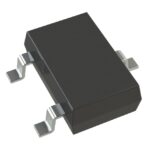 MMBV2108LT1
The activity of extra discounts on wholesale prices is in full swing…
Please fill in your contact information and we will send you the latest wholesale price list.





