 ChipApex | Global Electronic Components Supplier

SEARCH
Search Product
Search Post
— IC芯片 | 连接器 | 传感器 | 被动器件 —
Search productSearch post
— IC芯片 | 连接器 | 传感器 | 被动器件 —
Consult the customer manager about the wholesale price.
consultation hotline:86-132-6715-2157
email:[email protected]
Contact the product manager for consultation. One-stop consultation is available.
Do you want a lower wholesale price? Please send us your inquiry and we will reply immediately.
The MMDTD141 is an SMD digital NPN transistor manufactured by Diotec Semiconductor, housed in a SOT-23 (TO-236) package. It features integrated bias resistors with typical values of R1=10 kΩ and R2=10 kΩ, yielding a resistance ratio of 1:1. The device supports a maximum collector voltage (VO) of 50 V and a continuous collector current (IO) of 500 mA, with a total power dissipation (Ptot) of 200 mW at 25°C ambient temperature. Key electrical characteristics include a DC current gain (hFE) of 56 at VO=5V and IO=50mA, an input cutoff current of 0.88 mA at VI=5V, and a transition frequency (fT) of 200 MHz at VO=10V and IO=5mA. Operating temperatures range from -55°C to +150°C.
Verify the specific ordering suffix when purchasing. The standard version is suitable for commercial and industrial use. The -Q suffix indicates AEC-Q101 compliance, while the -AQ suffix denotes parts currently undergoing automotive qualification. Confirm these details against the official datasheet to ensure the component meets the required reliability standards for your specific application environment.
Select this component based on its 500 mA collector current capacity and 50 V breakdown voltage. Ensure the thermal management strategy accommodates the 200 mW power dissipation limit, particularly if leads are not maintained at ambient temperature. Verify that the 10 kΩ input resistor configuration aligns with the driving logic levels and impedance requirements of the upstream control signals.
This component belongs to the MMDTD series of surface-mount digital transistors. It integrates both NPN transistor functionality and internal biasing resistors into a single compact SOT-23 package. This integration reduces the component count and PCB footprint compared to discrete resistor-transistor combinations, making it suitable for dense electronic designs.
Consult the manufacturer's cross-reference documentation for verified substitutes. Ensure any replacement maintains identical pinout configurations, voltage ratings, and current handling capabilities to guarantee functional compatibility without requiring schematic modifications.
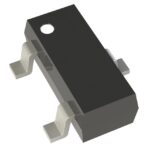 MMDTD141

The activity of extra discounts on wholesale prices is in full swing…
Please fill in your contact information and we will send you the latest wholesale price list.





