 ChipApex | Global Electronic Components Supplier
SEARCH
Search Product
Search Post
— IC芯片 | 连接器 | 传感器 | 被动器件 —
Search productSearch post
— IC芯片 | 连接器 | 传感器 | 被动器件 —
Consult the customer manager about the wholesale price.
consultation hotline:86-132-6715-2157
email:[email protected]
Contact the product manager for consultation. One-stop consultation is available.
Do you want a lower wholesale price? Please send us your inquiry and we will reply immediately.
The MMPQ2222AR1 is an NPN multi-chip general-purpose amplifier manufactured by onsemi. It integrates four discrete transistors within a single SOIC-16 surface-mount package, providing a compact solution for medium power amplification and switching applications requiring collector currents up to 500 mA. The device features a collector-emitter voltage of 45 V and a collector-base voltage of 75 V. Electrical characteristics include a minimum DC current gain of 35 at low currents, rising to 100 at higher loads, with a transition frequency of 300 MHz. Total device dissipation reaches 1,000 mW, supported by a junction-to-ambient thermal resistance of 125 °C/W across the four dies.
Verify the specific ordering suffix 'R1' against official manufacturer documentation to confirm tape and reel packing specifications. Ensure compatibility with standard SOIC-16 land patterns during PCB layout. Confirm that the component meets all necessary environmental compliance standards required for the target application before finalizing procurement orders.
Select this component when a design requires multiple NPN switching or amplifying elements in a confined footprint. The integrated four-die architecture offers superior thermal management compared to individual discrete packages. Evaluate the total power dissipation requirements against the 1,000 mW limit to ensure reliable operation under maximum load conditions.
This part belongs to the FFB2222A/FMB2222A/MMPQ2222A family of multi-chip amplifiers originally developed by Fairchild Semiconductor. Following corporate integration, these devices are now distributed under the onsemi brand. The MMPQ2222A variant specifically utilizes the larger SOIC-16 package to accommodate the four internal transistor structures while maintaining electrical isolation between channels.
Direct replacements include the FFB2222A (SC70-6) and FMB2222A (SSOT-6L), though these utilize different pinouts and package footprints. Verify mechanical fit and electrical pin mapping carefully when substituting smaller packages. Other generic NPN arrays may require significant circuit redesign due to differing internal configurations.
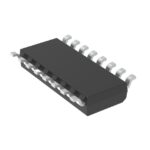 MMPQ2222AR1
The activity of extra discounts on wholesale prices is in full swing…
Please fill in your contact information and we will send you the latest wholesale price list.





