 ChipApex | Global Electronic Components Supplier

SEARCH
Search Product
Search Post
— IC芯片 | 连接器 | 传感器 | 被动器件 —
Search productSearch post
— IC芯片 | 连接器 | 传感器 | 被动器件 —
Consult the customer manager about the wholesale price.
consultation hotline:86-132-6715-2157
email:[email protected]
Contact the product manager for consultation. One-stop consultation is available.
Do you want a lower wholesale price? Please send us your inquiry and we will reply immediately.
The MMUN2131LT1 is a PNP Bipolar Digital Transistor (BRT) manufactured by onsemi. It integrates a single transistor with a monolithic bias network comprising a series base resistor and a base-emitter resistor within an SOT-23-3 package. Key electrical parameters include a maximum collector-emitter voltage (VCEO) of 50 V, a continuous collector current of 100 mA, and a power dissipation of 246 mW. The device features a typical input resistance of 2.2 kOhms with a resistor ratio of 1. It operates within a temperature range of -55°C to +150°C and has a minimum DC current gain (hFE) of 8.
Verify the specific suffix against the datasheet, as 'LT1' may indicate a specific packaging or revision variant distinct from the 'LT1G' version. Confirm RoHS compliance status directly with the manufacturer or authorized distributor documentation, as legacy part numbers may have varying environmental declarations. Ensure the source document explicitly lists MMUN2131LT1 without the 'G' suffix to avoid confusion with active inventory.
Select this component when a PNP digital transistor with a 2.2 kOhm base resistor is required. Compare the 2.2 kOhm input resistance against other variants like the MMUN2133L (4.7 kOhm) to ensure proper biasing for the target application. Verify that the 50 V voltage rating and 100 mA current capacity meet the circuit requirements. Check if the standard SOT-23-3 package fits the available footprint.
This component belongs to the MMUN21xxL series of pre-biased transistors designed to simplify BJT biasing. It serves as a direct replacement for discrete PNP transistors paired with external base and emitter resistors. The series is intended to reduce assembly costs and improve reliability by minimizing the number of surface-mount components required in low-power switching designs.
The MMUN2131LT1G is a functionally equivalent variant with RoHS compliance. Other series members such as MMUN2130L and MMUN2133L offer different resistor values but share similar electrical ratings.
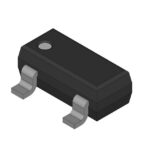 MMUN2131LT1

The activity of extra discounts on wholesale prices is in full swing…
Please fill in your contact information and we will send you the latest wholesale price list.





