ChipApex | Global Electronic Components Supplier
SEARCH
Search Product
Search Post
— IC芯片 | 连接器 | 传感器 | 被动器件 —
Search productSearch post
— IC芯片 | 连接器 | 传感器 | 被动器件 —
Consult the customer manager about the wholesale price.
consultation hotline:86-132-6715-2157
email:[email protected]
Contact the product manager for consultation. One-stop consultation is available.
Do you want a lower wholesale price? Please send us your inquiry and we will reply immediately.
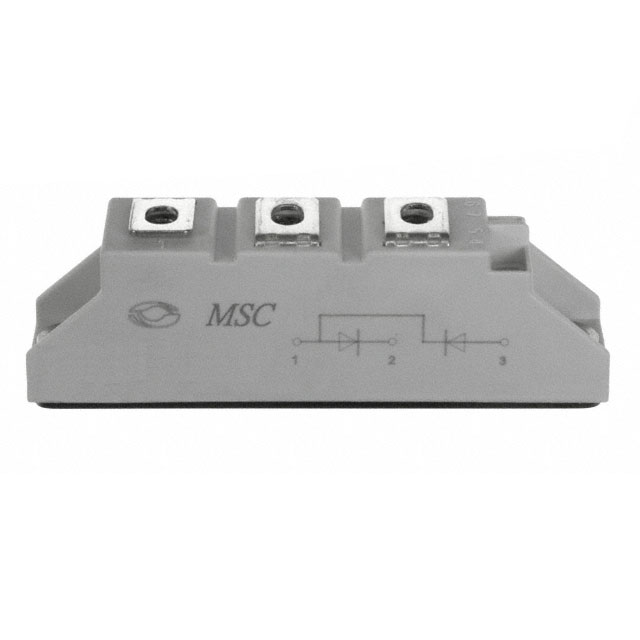
The MSAD100-16 is a power diode module manufactured by Microsemi Corporation, designed for high-voltage industrial applications. It features a reverse voltage rating of 1600 V and an average forward current of 100 A per diode. The device utilizes a D1 package configuration with a base-mount installation type. Electrical characteristics include a maximum reverse leakage current of 5 mA at the rated voltage and a forward voltage drop of 1.35 V measured at 300 A. The component operates within a junction temperature range of -40°C to 150°C and is classified as a standard recovery diode with a reverse recovery time exceeding 500 ns.
Verify component authenticity through authorized channels due to obsolete status. Confirm datasheet revisions and RoHS compliance history prior to integration. Validate mechanical mounting dimensions against existing PCB or chassis designs. Ensure thermal interface materials are compatible with the D1 baseplate specifications. Review supply chain availability for legacy replacement strategies.
Select this module when system requirements demand 1600 V isolation and 100 A current capacity in a compact form factor. Evaluate thermal resistance parameters to ensure adequate heat sinking for the operating environment. Consider the standard recovery characteristics for switching frequency limitations. Compare physical footprint constraints against alternative packages in the same series.
The MSAD100-16 belongs to the Microsemi MSAD series of high-power diode modules. This family provides reliable solutions for demanding power electronics applications requiring high voltage and current ratings. The D1 package offers standardized mounting options for easy integration into larger power assemblies. Related variants exist with different voltage ratings within the same current class.
Public confirmed substitute part numbers are not available in the provided documentation. The component is listed as obsolete. Engineers should consult manufacturer obsolescence notices for recommended alternatives or contact technical support for cross-reference data.
 MSAD100-16
The activity of extra discounts on wholesale prices is in full swing…
Please fill in your contact information and we will send you the latest wholesale price list.