ChipApex | Global Electronic Components Supplier

SEARCH
Search Product
Search Post
— IC芯片 | 连接器 | 传感器 | 被动器件 —
Search productSearch post
— IC芯片 | 连接器 | 传感器 | 被动器件 —
Consult the customer manager about the wholesale price.
consultation hotline:86-132-6715-2157
email:[email protected]
Contact the product manager for consultation. One-stop consultation is available.
Do you want a lower wholesale price? Please send us your inquiry and we will reply immediately.
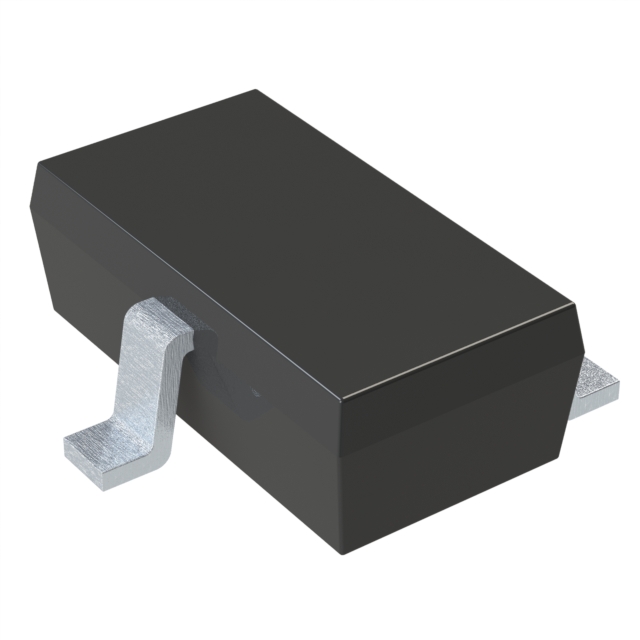
The MUN2216T1G is a single NPN Bias Resistor Transistor (BRT) housed in an SC-59 package. It integrates a monolithic bias network consisting of a series base resistor and a base-emitter resistor to replace discrete components. Key electrical parameters include a maximum collector-emitter voltage (VCEO) of 50 Vdc, continuous collector current (IC) of 100 mAdc, and input forward voltage of 30 Vdc. The typical input resistor R1 is 4.7 kOhms with a range of 3.3 to 6.1 kOhms. DC current gain (hFE) has a minimum of 160 at IC = 5.0 mA and VCE = 10 V. Power dissipation is 338 mW at 25°C ambient temperature, operating within a junction temperature range of -55°C to +150°C.
Verify the specific ordering suffix and marking code against the manufacturer's official documentation before procurement. Confirm that the SC-59 package style matches the required pinout configuration for the target application. Ensure compliance with RoHS and Pb-Free requirements as specified in the product data sheet. Check for any discontinuation notices or recommended new design alternatives if sourcing for long-term production.
Select this component when a compact NPN digital transistor solution is required with integrated biasing. Verify that the 50 V collector-emitter voltage and 100 mA continuous current ratings meet the circuit demands. Consider the thermal characteristics and power dissipation limits relative to the ambient operating temperature. Ensure the 4.7 kOhm typical base resistor value aligns with the intended drive conditions.
The MUN2216T1G belongs to the DTC143T series of digital transistors manufactured by onsemi. This series includes various packages such as SOT-23, SC-70, and SC-75, all sharing the same internal NPN transistor and 4.7 kOhm bias resistor network. The device is part of onsemi's portfolio of Bias Resistor Transistors designed to simplify circuit design and reduce assembly complexity.
Public confirmed substitute part numbers are not explicitly listed in the provided source material. Consult the manufacturer's documentation for potential cross-references or updated design recommendations.
 MUN2216T1G

The activity of extra discounts on wholesale prices is in full swing…
Please fill in your contact information and we will send you the latest wholesale price list.