 ChipApex | Global Electronic Components Supplier

SEARCH
Search Product
Search Post
— IC芯片 | 连接器 | 传感器 | 被动器件 —
Search productSearch post
— IC芯片 | 连接器 | 传感器 | 被动器件 —
Consult the customer manager about the wholesale price.
consultation hotline:86-132-6715-2157
email:[email protected]
Contact the product manager for consultation. One-stop consultation is available.
Do you want a lower wholesale price? Please send us your inquiry and we will reply immediately.
The MUN5115T1G is a single PNP digital transistor from onsemi, featuring an integrated base resistor. It operates with a maximum collector-emitter voltage of 50 V and a continuous collector current of 100 mA. The device includes a 10 kOhm base resistor (R1) and exhibits a minimum DC current gain (hFE) of 160 at 5 mA and 10 V. The saturation voltage is 250 mV maximum at 300 µA base current and 10 mA collector current. Power dissipation is rated at 202 mW, with a collector cutoff current of 500 nA maximum. It is housed in the SC-70-3 (SOT-323) surface-mount package.
Verify component authenticity through authorized distribution channels or direct manufacturer engagement. Confirm that the received parts match the MUN5115T1G designation and SC-70-3 packaging specifications. Check for AEC-Q100 qualification documentation if automotive compliance is required. Ensure storage conditions adhere to moisture sensitivity level 1 guidelines to prevent package damage during soldering processes.
Select this component when a single PNP configuration with a fixed 10 kOhm base resistance is required. Compare against alternative series such as MUN5114 or MUN5116 if different resistor values or NPN polarity are needed. Evaluate thermal performance based on the 202 mW power dissipation limit within the target enclosure environment. Verify compatibility with existing PCB footprints designed for SOT-323 packages.
This part belongs to the MUN5115 series of pre-biased transistors manufactured by onsemi. It serves as a compact alternative to discrete BJT and resistor combinations. The series is commonly used in portable devices and industrial controls where board space is limited. Related components include the dual-transistor variants like SMUN5115DW1T1G for differential applications.
Direct substitutes include other single PNP digital transistors with identical 10 kOhm base resistors and 50 V ratings. Verify pinout compatibility for SC-70-3 packages before substitution. Cross-reference datasheets for hFE and Vce(sat) tolerances to ensure functional equivalence in critical timing or gain-sensitive circuits.
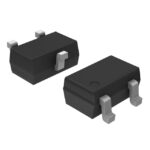 MUN5115T1G

The activity of extra discounts on wholesale prices is in full swing…
Please fill in your contact information and we will send you the latest wholesale price list.





