 ChipApex | Global Electronic Components Supplier

SEARCH
Search Product
Search Post
— IC芯片 | 连接器 | 传感器 | 被动器件 —
Search productSearch post
— IC芯片 | 连接器 | 传感器 | 被动器件 —
Consult the customer manager about the wholesale price.
consultation hotline:86-132-6715-2157
email:[email protected]
Contact the product manager for consultation. One-stop consultation is available.
Do you want a lower wholesale price? Please send us your inquiry and we will reply immediately.
The NE58633BS,115 is a stereo noise reduction class-D headphone driver amplifier. It operates from a single cell alkaline battery with a voltage range of 0.9 V to 1.7 V. The device integrates an on-chip DC-to-DC boost converter and internal voltage reference. Each channel includes a class-D BTL headphone driver, electret microphone low noise preamplifier, feedback noise reduction circuit, and music amplifier input. It drives 800 mVrms across 16 Ω or 32 Ω loads. The chip features mute control, plop and click reduction, ESD protection, and short-circuit protection. It is housed in a 32-pin HVQFN32 package.
Verify the specific ordering suffix '115' against official documentation to confirm tape and reel packaging details. Ensure compatibility with the specified 32-pin HVQFN32 package dimensions. Confirm that the component meets the required ambient temperature operating range of 0 °C to 70 °C for your application environment.
Select this component for applications requiring low current consumption and high immunity to noise via differential architecture. It is suitable for designs powered by a single cell alkaline battery where space is constrained. Consider the external resistor requirements for setting microphone and filter amplifier gains when designing the circuit.
The NE58633 is part of NXP's portfolio of audio amplifiers designed for portable consumer electronics. It specifically targets the noise-cancelling headphone market by combining power amplification with signal processing functions. The integration of the boost converter allows for extended battery life and simplified power supply design in compact devices.
No public confirmed substitute part numbers are available in the provided documentation.
The device incorporates dedicated plop and click reduction circuitry. A typical power-on delay time of 135 ms is imposed to allow input biasing to stabilize, which eliminates pop-on noise.
The internal reference voltage is pinned out at VREF to allow external filtering with a capacitor to ground. This enhances noise performance by decoupling the reference voltage.
Yes, if operated without the boost converter, pins B_IN, PVDDL, and PVDDR may be powered directly from a 3 V source, such as two AAA alkaline batteries, and the VBAT pin would not be used.
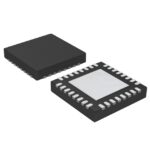 NE58633BS,115

The activity of extra discounts on wholesale prices is in full swing…
Please fill in your contact information and we will send you the latest wholesale price list.





