 ChipApex | Global Electronic Components Supplier
SEARCH
Search Product
Search Post
— IC芯片 | 连接器 | 传感器 | 被动器件 —
Search productSearch post
— IC芯片 | 连接器 | 传感器 | 被动器件 —
Consult the customer manager about the wholesale price.
consultation hotline:86-132-6715-2157
email:[email protected]
Contact the product manager for consultation. One-stop consultation is available.
Do you want a lower wholesale price? Please send us your inquiry and we will reply immediately.
The NE94433-T1B is an NPN silicon epitaxial bipolar transistor from the NE944 series, manufactured by CEL. It is designed for general-purpose UHF oscillator and mixer applications, including automotive keyless entry and TV tuner designs. The device offers stable oscillation with minimal frequency drift across supply voltage and temperature variations. Key electrical characteristics include a collector-to-base voltage (VCBO) of 30 V, collector-emitter voltage (VCEO) of 15 V, and a maximum collector current of 50 mA. It features a typical gain bandwidth product (fT) of 2.0 GHz, a feedback capacitance (CRE) of 0.55 pF, and a collector-to-base time constant of 5 ps. The component is housed in Package Code 33 and supports a total power dissipation of 150 mW.
Verify the package code matches the required footprint, as the datasheet specifies Package Code 33 for this part number. Confirm the ordering suffix indicates tape and reel packaging if automated assembly is intended. Ensure the manufacturer source is California Eastern Laboratories or an authorized distributor to guarantee component authenticity and traceability.
Select this component when designing UHF circuits requiring high fT and low feedback capacitance. Compare hFE ranges and thermal resistance values against specific bias conditions. Consider the 150 mW power dissipation limit and junction-to-ambient thermal resistance when determining heat sinking requirements for continuous operation.
The NE94433-T1B belongs to the NE944 series of NPN silicon epitaxial bipolar transistors produced by California Eastern Laboratories. This series is engineered for cost-effective performance in general-purpose UHF applications. The specific -T1B suffix denotes the tape and reel packaging configuration for the standard NE94433 device variant.
The datasheet lists the NEC 2SC3545 as the equivalent registered number for the NE94433. Verify pinout compatibility and electrical parameter tolerances before substitution. Cross-reference thermal resistance and maximum ratings to ensure the alternative meets the design's operational constraints.
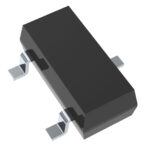 NE94433-T1B
The activity of extra discounts on wholesale prices is in full swing…
Please fill in your contact information and we will send you the latest wholesale price list.





