 ChipApex | Global Electronic Components Supplier

SEARCH
Search Product
Search Post
— IC芯片 | 连接器 | 传感器 | 被动器件 —
Search productSearch post
— IC芯片 | 连接器 | 传感器 | 被动器件 —
Consult the customer manager about the wholesale price.
consultation hotline:86-132-6715-2157
email:[email protected]
Contact the product manager for consultation. One-stop consultation is available.
Do you want a lower wholesale price? Please send us your inquiry and we will reply immediately.
The NHDTC123JTR is an NPN Resistor-Equipped Transistor (RET) from Nexperia, housed in a SOT23 (TO-236AB) surface-mounted package. It integrates bias resistors to simplify circuit design and reduce component count. Key electrical parameters include a collector-emitter voltage (VCEO) of 80 V and an output current capability of 100 mA. The built-in input resistor R1 is nominally 2.2 kΩ, while the base-emitter resistor R2 is 47 kΩ. The device features a DC current gain (hFE) of at least 100 at IC = 10 mA and a transition frequency (fT) of 170 MHz. It is AEC-Q101 qualified for automotive applications.
Verify the specific ordering suffix matches the required tape-and-reel configuration and manufacturing site code. Confirm that the marking code corresponds to the intended variant within the series. Ensure compatibility with standard SOT23 footprints during PCB layout. Check for any recent datasheet revisions that may affect qualification status or recommended operating conditions before finalizing procurement specifications.
Select this component when a compact NPN switch with integrated base biasing is required. The 2.2 kΩ input resistor value determines the base drive current relative to the input voltage. Ensure the application voltage does not exceed the 80 V collector-emitter rating. Consider the thermal resistance characteristics if operating near maximum power dissipation limits in confined spaces.
This part belongs to the NHDTC123JT/143ZT/114YT series, which shares identical packaging and general transistor characteristics but differs in the nominal value of the internal input resistor R1. The NHDTC123JT specifically uses a 2.2 kΩ resistor, whereas other variants use 4.7 kΩ or 10 kΩ. All variants maintain the same 47 kΩ output resistor R2 and package type.
The NHDTA123JT is the documented PNP complement within the same series. Direct substitution requires verifying polarity inversion and ensuring the replacement component meets the specific voltage and current requirements of the original circuit design.
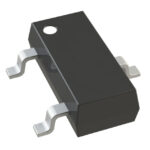 NHDTC123JTR

The activity of extra discounts on wholesale prices is in full swing…
Please fill in your contact information and we will send you the latest wholesale price list.





