 ChipApex | Global Electronic Components Supplier
SEARCH
Search Product
Search Post
— IC芯片 | 连接器 | 传感器 | 被动器件 —
Search productSearch post
— IC芯片 | 连接器 | 传感器 | 被动器件 —
Consult the customer manager about the wholesale price.
consultation hotline:86-132-6715-2157
email:[email protected]
Contact the product manager for consultation. One-stop consultation is available.
Do you want a lower wholesale price? Please send us your inquiry and we will reply immediately.
The NSVMMUN2114LT3G is a discontinued Bias Resistor Transistor (BRT) manufactured by onsemi. It integrates a single PNP transistor with a monolithic bias network consisting of a series base resistor and a base-emitter resistor within an SOT-23 package. The device features a collector-emitter voltage (VCEO) of 50 Vdc, continuous collector current of 100 mAdc, and power dissipation of 246 mW at 25°C. Electrical characteristics include a minimum DC current gain (hFE) of 80, typical input resistance of 10 kOhms, and a resistor ratio of 0.21. It operates within a junction temperature range of -55°C to +150°C.
Verify discontinuation status before procurement as this part is not recommended for new designs. Confirm availability of alternative sources or equivalent replacement devices from the manufacturer. Ensure compliance with specific automotive site and control change requirements associated with the NSV prefix if used in regulated environments.
Select this component only for legacy system maintenance or repair where original specifications are mandatory. Evaluate thermal performance based on the SOT-23 package dissipation limits. Consider the integrated resistor values for biasing compatibility. Assess alternative active parts if new design implementation is possible due to discontinued status.
This component belongs to the MUN2114L series of digital transistors. It shares electrical characteristics with other variants like MMUN2114LT1G but differs in packaging and ordering suffixes. The NSV prefix specifically denotes automotive-grade manufacturing controls. It is functionally similar to other BRTs in the DTA114Y family but utilizes distinct internal resistor configurations.
Public confirmed substitute part numbers: MMUN2114LT1G, MMUN2114LT3G.
The device contains a single PNP transistor with a monolithic bias network consisting of a series base resistor and a base-emitter resistor.
The NSV prefix indicates that the device is qualified under AEC-Q101 standards and is PPAP capable for automotive and other applications requiring unique site and control change requirements.
No, the datasheet explicitly lists this device as discontinued and states it is not recommended for new design.
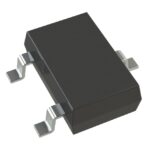 NSVMMUN2114LT3G
The activity of extra discounts on wholesale prices is in full swing…
Please fill in your contact information and we will send you the latest wholesale price list.





