ChipApex | Global Electronic Components Supplier
SEARCH
Search Product
Search Post
— IC芯片 | 连接器 | 传感器 | 被动器件 —
Search productSearch post
— IC芯片 | 连接器 | 传感器 | 被动器件 —
Consult the customer manager about the wholesale price.
consultation hotline:86-132-6715-2157
email:[email protected]
Contact the product manager for consultation. One-stop consultation is available.
Do you want a lower wholesale price? Please send us your inquiry and we will reply immediately.
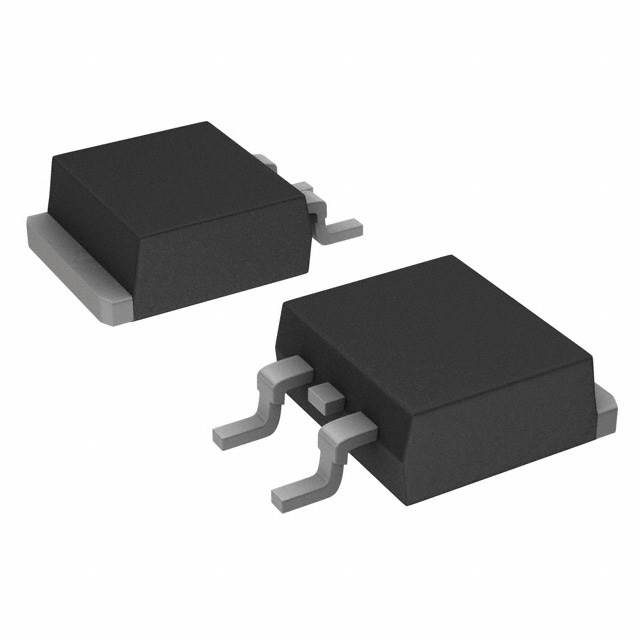
The NTSB30100CTT4G is a dual common-cathode Schottky rectifier manufactured by onsemi. It features a 100V repetitive peak reverse voltage and a 30A average forward current rating per diode. The device utilizes a trench Schottky barrier technology to achieve low forward voltage drop while maintaining stable switching characteristics across a wide temperature range. It is housed in a TO-263-3 (D2PAK) surface-mount package with an exposed tab for thermal management, designed for high-efficiency power conversion applications.
Verify the specific ordering suffix T4G confirms tape-and-reel packaging when sourcing. Confirm RoHS compliance and halogen-free status through official manufacturer documentation or component material declarations prior to integration. Ensure the D2PAK footprint matches the design layout, paying attention to the thermal pad dimensions for proper heat dissipation requirements.
Select this component for applications requiring high current handling at moderate voltages with strict efficiency targets. The trench technology offers superior performance over standard planar Schottky diodes regarding the trade-off between forward voltage and reverse leakage current. Consider the thermal resistance of the TO-263 package when designing heatsinking solutions for continuous 30A operation.
This part belongs to onsemi's NTST series of trench Schottky rectifiers. The series is engineered to replace traditional planar Schottky diodes in high-frequency power supply designs. The dual common-cathode variant simplifies circuit topology by reducing component count and board space compared to using discrete single-diode packages.
The trench technology enables a lower forward voltage drop than planar Schottky diodes while preventing the high reverse leakage currents typically associated with reduced forward voltage in other technologies.
The package includes an exposed metal tab on the underside that connects to the cathode, allowing direct soldering to a PCB copper pour or heatsink to dissipate heat generated during high-current operation.
 NTSB30100CTT4G
The activity of extra discounts on wholesale prices is in full swing…
Please fill in your contact information and we will send you the latest wholesale price list.