 ChipApex | Global Electronic Components Supplier
SEARCH
Search Product
Search Post
— IC芯片 | 连接器 | 传感器 | 被动器件 —
Search productSearch post
— IC芯片 | 连接器 | 传感器 | 被动器件 —
Consult the customer manager about the wholesale price.
consultation hotline:86-132-6715-2157
email:[email protected]
Contact the product manager for consultation. One-stop consultation is available.
Do you want a lower wholesale price? Please send us your inquiry and we will reply immediately.
The NTSB30120CT-1G is a dual Schottky power rectifier manufactured by onsemi, featuring a common cathode configuration. It utilizes silicon technology and is housed in an I2PAK (TO-247) through-hole package with three terminals. The device supports a maximum continuous forward current of 30 A and a repetitive peak reverse voltage of 120 V. Key electrical characteristics include a typical forward voltage of 1.18 V at rated current and a maximum reverse leakage current of 800 uA. It withstands a non-repetitive peak forward surge current of 60 A and operates within a junction temperature range of -40°C to +150°C.
Verify the specific suffix '-1G' against the manufacturer's latest datasheet to confirm compliance with RoHS and REACH directives. Ensure the I2PAK footprint matches the target PCB design. Confirm availability status as older series components may be subject to discontinuation or lifecycle changes. Cross-reference pinout configurations to prevent installation errors during assembly.
Select this component when a dual common cathode Schottky rectifier is required for medium-power applications. The I2PAK package offers superior thermal dissipation compared to smaller surface-mount options. Evaluate the 30 A current rating against peak load requirements to ensure adequate margin. Consider the 120 V voltage rating relative to the system's maximum operating voltage to prevent breakdown.
This part belongs to onsemi's NTSB series of high-current Schottky rectifiers. It shares functional similarities with the NTSV30120CTG but differs in packaging, utilizing the larger I2PAK form factor for enhanced heat sinking. It serves as a discrete alternative to integrated power modules in standard industrial and consumer power electronics designs.
The NTST30120CTG is a documented equivalent from the same manufacturer, offering identical electrical specifications but in a TO-220AB package. Verify mechanical compatibility before substitution due to the difference in package dimensions and mounting hole spacing.
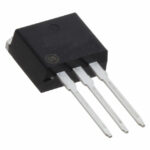 NTSB30120CT-1G
The activity of extra discounts on wholesale prices is in full swing…
Please fill in your contact information and we will send you the latest wholesale price list.





