 ChipApex | Global Electronic Components Supplier
SEARCH
Search Product
Search Post
— IC芯片 | 连接器 | 传感器 | 被动器件 —
Search productSearch post
— IC芯片 | 连接器 | 传感器 | 被动器件 —
Consult the customer manager about the wholesale price.
consultation hotline:86-132-6715-2157
email:[email protected]
Contact the product manager for consultation. One-stop consultation is available.
Do you want a lower wholesale price? Please send us your inquiry and we will reply immediately.
The Nexperia PBRP123ET-QR is a PNP Performance-Based Resistor-Equipped Transistor (RET) housed in an SOT-23 (TO-236AB) surface-mount package. It integrates bias resistors R1 and R2, both nominally 2.2 kΩ with ±10% ratio tolerance. The device supports a collector-emitter voltage (VCEO) of -40 V and a continuous output current (IO) of -600 mA. Key electrical characteristics include a DC current gain (hFE) ranging from 70 to 250 depending on operating conditions, and a low collector-emitter saturation voltage (VCEsat). It is qualified according to AEC-Q101 for automotive applications.
Verify the specific suffix 'QR' against the manufacturer's official ordering information to confirm packaging details such as reel size or tape specifications. Ensure the requested part matches the exact product data sheet version to avoid discrepancies in marking codes or thermal characteristics. Cross-reference the AEC-Q101 qualification status if the application requires strict automotive compliance standards.
Select this component when a compact PNP solution with built-in biasing is required for space-constrained designs. The SOT-23 package offers a small footprint suitable for high-density PCB layouts. Consider the -40 V rating and 600 mA current limit to ensure adequate headroom for the intended load. Verify that the integrated resistor values align with the driving logic levels and desired saturation performance.
This device belongs to Nexperia's PBRP series of Performance-Based Resistor-Equipped Transistors. It serves as the PNP counterpart to the NPN PBRN123ET-Q. The series is designed to replace discrete transistor and resistor combinations, offering reduced pick-and-place costs and simplified assembly processes in both industrial and automotive electronics manufacturing.
Direct functional substitutes within the same family include the PBRP123ET without the automotive qualification suffix. Other compatible RETs may include variants with different resistor values or packages, but pin compatibility must be verified. Always consult the latest datasheet for any changes in mechanical dimensions or electrical limits before substitution.
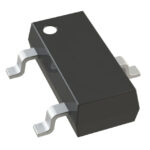 PBRP123ET-QR
The activity of extra discounts on wholesale prices is in full swing…
Please fill in your contact information and we will send you the latest wholesale price list.





