 ChipApex | Global Electronic Components Supplier

SEARCH
Search Product
Search Post
Search productSearch post
Consult the customer manager about the wholesale price.
consultation hotline:86-132-6715-2157
email:[email protected]
Contact the product manager for consultation. One-stop consultation is available.
Do you want a lower wholesale price? Please send us your inquiry and we will reply immediately.
PBSS5140T,215 is listed in the Single Bipolar Transistors range at ChipApex. The manufacturer field lists Nexperia USA Inc. Its product description is TRANS PNP 40V 1A TO-236AB. Review the specifications below when checking this part for your BOM.
The PBSS5140T,215 is a PNP low VCEsat transistor manufactured by Nexperia in a SOT23 (TO-236AB) surface-mount package. It features a maximum collector-emitter voltage of -40 V and a continuous collector current of -1 A, with a peak pulse current capability of -2 A. The device exhibits a typical collector-emitter saturation resistance of 300 mΩ at -500 mA collector current. DC current gain ranges from 160 to 800 depending on operating conditions. Thermal characteristics include a junction-to-ambient thermal resistance of 417 K/W in free air. The component operates within an ambient temperature range of -65 °C to +150 °C and is qualified under the AEC-Q101 standard for automotive applications.
Verify the specific ordering suffix matches the required packaging configuration before procurement. Confirm that the component version aligns with the latest product data sheet revision to ensure compatibility with design specifications. Check for any updates regarding the manufacturing site code indicated by the marking prefix. Ensure compliance with automotive qualification requirements if deploying in vehicle systems.
Select this component when a compact PNP transistor with low saturation voltage is required for space-constrained designs. Consider the SOT23 package dimensions for PCB layout constraints. Evaluate the thermal resistance values against the expected power dissipation in the target application environment. Verify that the voltage and current ratings exceed the maximum operational stresses of the circuit.
This part belongs to the PBSS series of low VCEsat transistors designed for high-efficiency switching. The NPN complement for this device is the PBSS4140T. Both components share similar electrical characteristics tailored for general-purpose switching tasks. The series utilizes silicon technology optimized for reduced heat generation during conduction.
The NPN complement PBSS4140T serves as the counterpart in complementary circuits. Direct substitution requires verifying polarity inversion and matching voltage and current ratings. Ensure the replacement maintains the same package type and pinout configuration to fit existing footprints without redesign.
The maximum peak collector current is -2 A for single pulses with a duration of 1 ms or less.
The marking code consists of the character '2H', preceded by a placeholder symbol representing the manufacturing site code.
The transition frequency is typically 150 MHz when measured at a collector-emitter voltage of -10 V and a collector current of -50 mA.
Explore related parts through Bipolar (BJT), Transistors, Discrete Semiconductor Products, all product categories.
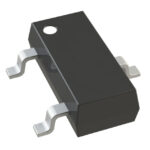 PBSS5140T,215

The activity of extra discounts on wholesale prices is in full swing…
Please fill in your contact information and we will send you the latest wholesale price list.





