 ChipApex | Global Electronic Components Supplier
SEARCH
Search Product
Search Post
— IC芯片 | 连接器 | 传感器 | 被动器件 —
Search productSearch post
— IC芯片 | 连接器 | 传感器 | 被动器件 —
Consult the customer manager about the wholesale price.
consultation hotline:86-132-6715-2157
email:[email protected]
Contact the product manager for consultation. One-stop consultation is available.
Do you want a lower wholesale price? Please send us your inquiry and we will reply immediately.
The PDTA144VT,215 is a PNP resistor-equipped transistor from the PDTA144V series, housed in an SOT23 surface-mount package. It integrates bias resistors with typical values of R1 = 47 kΩ and R2 = 10 kΩ, yielding a ratio of 0.21. The device supports a collector-emitter voltage (VCEO) of -50 V and a continuous DC output current (IO) of -100 mA. Total power dissipation is rated at 250 mW at 25 °C ambient temperature. The junction temperature maximum is 150 °C, with a storage temperature range spanning from -65 °C to +150 °C.
Verify the specific ordering suffix against official Nexperia documentation to confirm package type and marking code accuracy. Confirm RoHS compliance status and manufacturing origin details via the manufacturer's latest product data sheet or authorized distributor channels before finalizing procurement specifications.
Select this component for applications requiring a compact PNP solution with integrated base biasing. Ensure the required collector-emitter voltage exceeds -50 V and the load current remains within the -100 mA limit. Verify that the SOT23 package dimensions align with the target PCB footprint and thermal management requirements.
This part belongs to the PDTA144V series of PNP resistor-equipped transistors manufactured by Nexperia. The series includes variants in packages such as SOT883, SOT323, and SOT54. The PDTA144VT specifically utilizes the SOT23 package, offering a standard surface-mount form factor suitable for general-purpose discrete semiconductor applications.
Direct substitutes include other PDTA144V series members like PDTA144VM or PDTA144U if package compatibility allows. Cross-brand equivalents should be evaluated based on matching VCEO, IO, and internal resistor ratios.
The typical value for R1 (input) is 47 kΩ, and the typical value for R2 is 10 kΩ.
The maximum total power dissipation (Ptot) for the SOT23 package is 250 mW at an ambient temperature of 25 °C.
The provided datasheet does not list AEC-Q101 qualification for the PDTA144V series; therefore, its suitability for automotive use requires verification against specific automotive-grade variants or additional manufacturer certification.
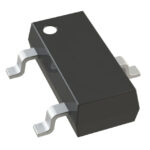 PDTA144VT,215
The activity of extra discounts on wholesale prices is in full swing…
Please fill in your contact information and we will send you the latest wholesale price list.




