 ChipApex | Global Electronic Components Supplier
SEARCH
Search Product
Search Post
— IC芯片 | 连接器 | 传感器 | 被动器件 —
Search productSearch post
— IC芯片 | 连接器 | 传感器 | 被动器件 —
Consult the customer manager about the wholesale price.
consultation hotline:86-132-6715-2157
email:[email protected]
Contact the product manager for consultation. One-stop consultation is available.
Do you want a lower wholesale price? Please send us your inquiry and we will reply immediately.
The PDTB113EUX is a PNP Resistor-Equipped Transistor (RET) manufactured by Nexperia, housed in an SOT323 (SC-70) surface-mounted package. It features built-in bias resistors with R1 at 1 kΩ and R2 at 1 kΩ. The device supports a maximum collector-emitter voltage of -50 V and an output current of -500 mA. Key electrical characteristics include a DC current gain (hFE) minimum of 33 at -50 mA, a collector-emitter saturation voltage of -100 mV at -50 mA, and a transition frequency of 140 MHz. It operates within a junction temperature range up to 175 °C and is qualified under the AEC-Q101 standard.
Verify the specific ordering suffix against the manufacturer's latest documentation to confirm packaging details and manufacturing origin. Ensure that the selected variant matches the required resistor values and package type for your specific application constraints. Cross-reference the part number with official distributor catalogs to confirm availability and compliance with current RoHS standards before finalizing procurement plans.
Select this component when a compact PNP switching solution with integrated biasing is required. The SOT323 package offers space efficiency for dense PCB layouts. Consider the 1 kΩ input resistance for driving capabilities and verify that the -50 V rating aligns with the system's voltage requirements. The AEC-Q101 qualification makes it suitable for automotive environments where reliability is critical.
This device belongs to the PDTB1xxxU series of PNP resistor-equipped transistors from Nexperia. It serves as the PNP complement to the NPN PDTD113EU. The series includes variants with different resistor ratios, such as the PDTB113ZU and PDTB123EU, allowing designers to choose based on specific biasing needs while maintaining the same small form factor and performance characteristics.
Direct functional equivalents within the same family include the PDTB113ZU, which differs primarily in the R2 resistor value. Designers should verify pin compatibility and thermal characteristics when substituting between RET variants to ensure circuit stability.
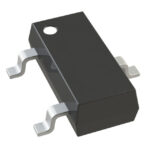 PDTB113EUX
The activity of extra discounts on wholesale prices is in full swing…
Please fill in your contact information and we will send you the latest wholesale price list.





